


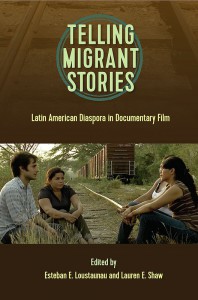
Telling Migrntt Stories
Latin American Diaspora in Documentary Film
Sous la direction de Esteban E. Loustaunau et Lauren E. Shaw


 (0 vote)
Moyenne des votes :
| 0 | vote |  = On peut s'en passer = On peut s'en passer |
| 0 | vote |  = Bon livre = Bon livre |
| 0 | vote |  = Excellent livre = Excellent livre |
| 0 | vote |  = Unique / une référence = Unique / une référence |
Votre vote : -
Description de l'ouvrage:
In the media, migrants are often portrayed as criminals; they are frequently dehumanized, marginalized, and unable to share their experiences. Telling Migrant Stories explores how contemporary documentary film gives voice to Latin American immigrants whose stories would not otherwise be heard.
The essays in the first part of the volume consider the documentary as a medium for Latin American immigrants to share their thoughts and experiences on migration, border crossings, displacement, and identity. Contributors analyze films including Harvest of Empire, Sin pa's, The Vigil, De nadie, Operation Peter Pan: Flying Back to Cuba, Abuelos, La Churona, and Which Way Home, as well as internet documentaries distributed via platforms such as Vimeo and YouTube. They examine the ways these films highlight the individual agency of immigrants as well as the global systemic conditions that lead to mass migrations from Latin American countries to the United States and Europe.
The second part of the volume features transcribed interviews with documentary filmmakers, including Luis Argueta, Jenny Alexander, Tin Dirdamal, Heidi Hassan, and Mar a Cristina Carrillo Espinosa. They discuss the issues surrounding migration, challenges they faced in the filmmaking process, the impact their films have had, and their opinions on documentary film as a force of social change. They emphasize that because the genre is grounded in fact rather than fiction, it has the ability to profoundly impact audiences in a way narrative films cannot. Documentaries prompt viewers to recognize the many worlds migrants depart from, to become immersed in the struggles portrayed, and to consider the stories of immigrants with compassion and solidarity. Contributors: Ram n Guerra Lizardo Herrera Jared List Esteban Loustaunau Manuel F. Medina Ada Ort zar-Young Thomas Pi eros Shields Juan G. Ramos Lauren Shaw Zaira Zarza A volume in the series Reframing Media, Technology, and Culture in Latin/o America, edited by H ctor Fern ndez L'Hoeste and Juan Carlos Rodr guez.
À propos des auteurs :
Esteban E. Loustaunau is associate professor of Spanish at Assumption College. Lauren E. Shaw, associate professor of Spanish at Elmira College, is the editor of Song and Social Change in Latin America.
Voir le site internet de l'éditeur University Press of Florida
> Sur un thème proche :

Discourses of Migration in Documentary Film (2022)
Translating the Real to the Reel
Sujet : Genre > Documentary
Projecting Migration (2008)
Transcultural Documentary Practice, includes DVD-ROM
Dir. Alan Grossman et Áine O'Brien
Sujet : Genre > Documentary
Mediating Mobility (2016)
Visual Anthropology in the Age of Migration
de Steffen Köhn
Sujet : Sociology


André Bazin on Documentary (2026)
Cinema's Urge to Explore
Dir. André Bazin
Sujet : Genre > Documentary

Staging Nuremberg (2026)
How the United States and the Soviet Union Fought Over the Portrayal of Nazi Crimes
Sujet : Genre > Documentary
Interactive Documentary and Non-Fiction Media (2026)
Relational Practice and (De)Stabilized Reception
Dir. Tobias Conradi, Florian Krautkrämer et Vanessa Zallot
Sujet : Genre > Documentary
 Retour