


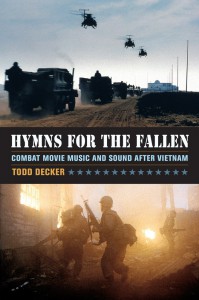
Hymns for the Fallen
Combat Movie Music and Sound after Vietnam
by Todd Decker


 (0 vote)
Average rating:
| 0 | rating |  = We can do without = We can do without |
| 0 | rating |  = Good book = Good book |
| 0 | rating |  = Excellent book = Excellent book |
| 0 | rating |  = Unique / a reference = Unique / a reference |
Your rating: -
Book Presentation:
In Hymns for the Fallen, Todd Decker listens closely to forty years of Hollywood combat films produced after Vietnam. Ever a noisy genre, post-Vietnam war films have deployed music and sound to place the audience in the midst of battle and to provoke reflection on the experience of combat. Considering landmark movies—such as Apocalypse Now, Saving Private Ryan, The Thin Red Line, Black Hawk Down, The Hurt Locker, and American Sniper—as well as lesser-known films, Decker shows how the domain of sound, an experientially rich and culturally resonant aspect of cinema, not only invokes the realities of war, but also shapes the American audience’s engagement with soldiers and veterans as flesh-and-blood representatives of the nation. Hymns for the Fallen explores all three elements of film sound—dialogue, sound effects, music—and considers how expressive and formal choices in the soundtrack have turned the serious war film into a patriotic ritual enacted in the commercial space of the cinema.
About the Author:
Todd Decker is Professor of Music at Washington University in St. Louis. The author of four books on American commercial music and media, he has lectured at the Library of Congress, London’s Victoria and Albert Museum, and LabEx Arts-H2H in Paris.
Press Reviews:
"The measure of any study, regardless of the field, is its ability to provide new insights and approaches to critical analysis and thus facilitate greater understanding. Such new approaches are particularly important for the mechanisms of cinematic genre because of genre’s dynamic tendency to reflect a given period’s cultural attitudes. Decker’s monograph accomplishes all of this. It is a welcome addition to the literature and will not gather dust on the bookshelf of anyone who is interested in film form in general and in the film score in particular."— American Music
"In this dynamic study, Todd Decker explores the significance of sound in four historic cycles of Hollywood combat films. Made in the decades following the Vietnam War, these movies reflect the changing public psyche, with shifting perspectives on soldiers, veterans, sacrifice, catharsis, and memorialization. What the audience hears is key to evolving narrative and political strategies, and the insightful holistic focus on all soundtrack elements—dialogue, sound, and music—reveals the complex ethical territories and representational maneuvers of films that exploit violence while simultaneously making moral statements about violence."—Miguel Mera, City, University of London
"Decker has captured the aesthetic, emotional, and narrative sorcery of modern combat films' soundscapes, and has woven engaging and articulate close analyses of the musical, vocal, and sound-effect components that illustrate the most bombastic and sensitive filmic moments. He reveals the sonic elegance behind the tragic despair."—Vanessa Theme Ament, author of The Foley Grail: The Art of Performing Sound for Film, Games, and Animation
"By undertaking a meticulous and far-reaching sound analysis of a broad array of war films, Decker reveals hidden continuities that a normal audience member could never discern. This is extremely important work, because these hidden structures are subtly shaping contemporary attitudes to war, and to violence more broadly. Decker doesn’t merely describe how music, voice, and sound work in these films (although he does do this, admirably); he also helps us understand how these films work on us. Given the extent to which popular ideas about war and ethics are formulated through cinematic experiences, this book should be required reading."—J. Martin Daughtry, author of Listening to War: Sound, Music, Trauma, and Survival in Wartime Iraq
> From the same author:
Astaire by Numbers (2022)
Time & the Straight White Male Dancer
by Todd Decker
Subject: Actor > Fred Astaire
> On a related topic:

German Ways of War (2022)
The Affective Geographies and Generic Transformations of German War Films
For No Reason at All (2022)
The Changing Narrative of the First World War in American Film
Mediating War and Identity (2020)
Figures of Transgression in 20th- and 21st-century War Representation
Dir. Lisa Purse and Ute Wölfel

Destructive Sublime (2018)
World War II in American Film and Media
Specters of War (2012)
Hollywood's Engagement with Military Conflict

The Naval War Film (2007)
Genre, History and National Cinema


Search and Clear (1988)
Critical Responses to Selected Literature and Films of the Vietnam War
Dir. William J. Searle

 Back
Back

