


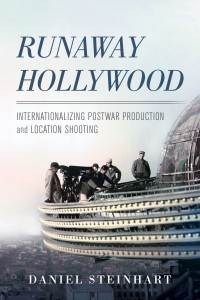
Runaway Hollywood
Internationalizing Postwar Production and Location Shooting


 (0 vote)
Average rating:
| 0 | rating |  = We can do without = We can do without |
| 0 | rating |  = Good book = Good book |
| 0 | rating |  = Excellent book = Excellent book |
| 0 | rating |  = Unique / a reference = Unique / a reference |
Your rating: -
Book Presentation:
After World War II, as cultural and industry changes were reshaping Hollywood, movie studios shifted some production activities overseas, capitalizing on frozen foreign earnings, cheap labor, and appealing locations. Hollywood unions called the phenomenon “runaway” production to underscore the outsourcing of employment opportunities. Examining this period of transition from the late 1940s to the early 1960s, Runaway Hollywood shows how film companies exported production around the world and the effect this conversion had on industry practices and visual style. In this fascinating account, Daniel Steinhart uses an array of historical materials to trace the industry’s creation of a more international production operation that merged filmmaking practices from Hollywood and abroad to produce movies with a greater global scope.
About the Author:
Daniel Steinhart is Assistant Professor of Cinema Studies at the University of Oregon. His work on film and media has appeared in Cinema Journal, NECSUS: European Journal of Media Studies, InMedia: The French Journal of Media Studies, and various edited collections.
Press Reviews:
"How exactly does an industry with a production wing based in Los Angeles begin to make movies on other continents? To answer this question, Daniel Steinhart has conducted an extraordinary amount of original research drawing on primary sources from European and US archives. Advancing an innovative transcultural argument, he details how Hollywood’s production culture subtly changed as its workers encountered the norms of other industries. The result is a major contribution to our understanding of postwar Hollywood cinema—and it is the definitive study of runaway production."—Patrick Keating, Associate Professor of Communication, Trinity University
"For those who think the idea of runaway film came out of Canada, Steinhart’s Runaway Hollywood shows us how film production has always gravitated to the lowest cost location. To that scenario, he adds archival insights on the cross-cultural dimensions of making US movies abroad."—Vicki Mayer, Professor of Communication, Tulane University
"Steinhart offers an ingenious bottom-up perspective on Hollywood’s overseas filmmaking ventures during the postwar period, demonstrating the myriad ways that practical and aesthetic concerns intertwined with larger questions of economic and cultural influence. By doing so, he makes an essential and welcome contribution to the critical literature on global Hollywood."—Michael Curtin, Duncan and Suzanne Mellichamp Professor of Film and Media Studies, University of California, Santa Barbara
> On a related topic:
Rock around the Clock (2025)
Exploitation, Rock 'n' roll and the Origins of Youth Culture
by Yannis Tzioumakis and Siân Lincoln
Subject: One Film > Rock around the Clock
Filmonomics (2025)
Economists Discuss the Silver Screen
Dir. André de Palma and Luc Leruth
Subject: Economics
Television's Second Golden Age (2025)
Politics and International Relations in the Era of HBO and Streaming TV
Subject: Economics
Global Development of Asian Cinema in the Film Industry (2025)
Dir. Changsong Wang, Cheng Fei Yong and Rustono Farady Marta
Subject: Economics
Micro-Budget Methods of Cinematic Storytelling (2025)
A Practical Guide to Making Narrative Media with Minimal Means
by Jake Mahaffy
Subject: Economics

Capturing Big Ideas for Less in Feature Film (2025)
How a Limited Environment Can Serve Substantial Themes
Subject: Economics

The Co-production Landscape in Europe (2025)
From Eurimages to Netflix
by Petar Mitric
Subject: Economics
 Back
Back

