


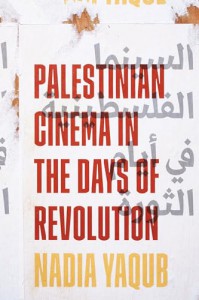
Palestinian Cinema in the Days of Revolution
de Nadia Yaqub


 (0 vote)
Moyenne des votes :
| 0 | vote |  = On peut s'en passer |
| 0 | vote |  = Bon livre |
| 0 | vote |  = Excellent livre |
| 0 | vote |  = Unique / une référence |
Votre vote : -
Description de l'ouvrage:
Palestinian cinema arose during the political cinema movements of the late 1960s and early 1970s, yet it was unique as an institutionalized, though modest, film effort within the national liberation campaign of a stateless people. Filmmakers working within the Palestinian Liberation Organization (PLO) and through other channels filmed the revolution as it unfolded, including the Israeli bombings of Palestinian refugee camps, the Jordanian and Lebanese civil wars, and Palestinian life under Israeli occupation, attempting to create a cinematic language consonant with the revolution and its needs. They experimented with form both to make effective use of limited material and to process violent events and loss as a means of sustaining active engagement in the Palestinian political project.
Palestinian Cinema in the Days of Revolution presents an in-depth study of films made between 1968 and 1982, the filmmakers and their practices, the political and cultural contexts in which the films were created and seen, and their afterlives among Palestinian refugees and young filmmakers in the twenty-first century. Nadia Yaqub discusses how early Palestinian cinema operated within emerging public-sector cinema industries in the Arab world, as well as through coproductions and solidarity networks. Her findings aid in understanding the development of alternative cinema in the Arab world. Yaqub also demonstrates that Palestinian filmmaking, as a cinema movement created and sustained under conditions of extraordinary precarity, offers important lessons on the nature and possibilities of political filmmaking more generally.
Voir le site internet de l'éditeur University of Texas Press
> Sur un thème proche :

An Atonal Cinema (2025)
Resistance, Counterpoint and Dialogue in Transnational Palestine
Sujet : Countries > Middle East
Reel Gender (2024)
Palestinian and Israeli Cinema
Dir. Sa'ed Atshan et Katharina Galor
Sujet : Countries > Middle East
Representations of Palestine in Egyptian Cinema (2023)
Politics of (In)visibility
Sujet : Countries > Middle East
Israel/Palestine (2021)
Border Representations in Literature and Film
de Drew Paul
Sujet : Countries > Middle East
Visualizing the Palestinian Struggle (2016)
Towards a Critical Analytic of Palestine Solidarity Film
Sujet : Countries > Middle East
Mainstreaming Palestine (2025)
Cinematic Activism and Solidarity Politics in the United States
Sujet : Countries > Middle East
The Afterlife of Palestinian Images (2024)
Visual Remains and the Archive of Disappearance
Sujet : Countries > Middle East

The Palestinian Idea (2019)
Film, Media, and the Radical Imagination
de Greg Burris
Sujet : Countries > Middle East
 Retour


