

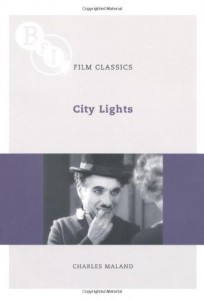
City Lights


 (0 vote)
Moyenne des votes :
| 0 | vote |  = On peut s'en passer = On peut s'en passer |
| 0 | vote |  = Bon livre = Bon livre |
| 0 | vote |  = Excellent livre = Excellent livre |
| 0 | vote |  = Unique / une référence = Unique / une référence |
Votre vote : -
Description de l'ouvrage:
In 1967, Charlie Chaplin told an interviewer, "I think I like City Lights the best of all my films." Speaking of the film's famous ending, James Agee wrote that "it is enough to shrivel the heart to see." Although City Lights had a long and extremely difficult production history, the final film, in Alistair Cooke's apt words, flows "like water over pebbles, smooth and simple for all to see with no hint of the groaning pressure that had gone into it." It could easily have been otherwise. Chaplin began the film in 1927, even before the release of The Circus, just months after a highly publicized divorce from his second wife and a tax dispute with the U.S. government, both of which cost him dearly. In addition, Chaplin's mother, with whom he had a close and complex relationship, died in August 1928. Besides the burden of these financial and emotional strains, Chaplin also had to contend with the transition of the American film industry to the talkies and the downward spiral of the depression following the Stock Market Crash in October 1929. He chose a novice actress, Virginia Cherrill, as the female lead for the film, and during production he fired the man originally cast as the millionaire and fired, then re-hired, Cherrill. Yet he pressed forward, releasing the film to much acclaim and box-office success in the first two months of 1931. Aesthetically, technologically, and culturally, City Lights is a key transitional film in Chaplin's body of work, as the director/writer/actor responded for the first time to sound films and stepped in the direction of the social commentary that would become more overt in Modern Times (1936) and The Great Dictator (1940). Based on extensive archival research of Chaplin's production records, Charles Maland's City Lights offers a careful history of the film's production and reception, as well as a close examination of the film itself, with special attention to the sources of the final scene's emotional power.
À propos de l'auteur :
Charles Maland is Professor of Cinema Studies, American Studies and English at the University of Tennessee.
Voir le site internet de l'éditeur BFI Publishing
Voir la fiche de City Lights (1931) sur le site IMDB ...
> Du même auteur :

American Visions (1977)
The Films of Chaplin, Ford, Capra and Welles 1936-1941
Sujet : Director > Charlie Chaplin, Frank Capra, John Ford, Orson Welles
> Sur un thème proche :

Silent Traces (2006)
Discovering Early Hollywood Through the Films of Charlie Chaplin
Sujet : Director > Charlie Chaplin
Charles Chaplin's City Lights (1983)
Its Production and Dialectical Structure
Sujet : One Film > City Lights
Charles Chaplin's The Freak (2025)
The Story of an Unfinished Film
Charlie Chaplin's Modern Times (2024)
The Work of Life in the Age of Mechanical Reproducibility
de Carl Peters
Sujet : One Film > Modern Times
Charlie Chaplin and A Woman of Paris (2021)
The Genesis of a Misunderstood Masterpiece
Sujet : One Film > A Woman of Paris


 Retour