


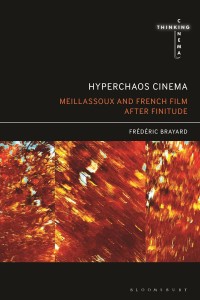
Hyperchaos Cinema
Meillassoux and French Film After Finitude


 (0 vote)
Average rating:
| 0 | rating |  = We can do without |
| 0 | rating |  = Good book |
| 0 | rating |  = Excellent book |
| 0 | rating |  = Unique / a reference |
Your rating: -
Book Presentation:
Hyperchaos Cinema develops a film-philosophy that resonates with the Speculative Turn and the Nonhuman Turn. Engaging with the philosophy of Quentin Meillassoux, it argues that the absolute, the real independent from us, consists in what Meillassoux calls absolute contingency, or the possibility for everything to be what it is not.
Since the beginning of the 21st century, the proliferating assemblages of human and digital images that shape our daily experience of reality have created a complex relationship between human thought, filmic thought and the world. Hyperchaos Cinema posits that digital cinema can think the real, understood as what exists without us, without neither thought nor subjectivity. Hyperchaos is the time through which absolute contingency expresses itself, which can change anything at any moment and for no reason. This book explores digital cinema's ability to produce images that can express the being-other of any sound, image, movement, entity or process in a cinematic time that allows any possible change.
The films explored, including Rubber, Holy Motors, Bird People, Réalité and The Image Book, shift their paradigm of time from the human-centred perspective of duration, process and becoming to hyperchaos. The analysis illuminates how film can produce images of diegetic worlds no longer regulated by stable, immutable rules. By considering how hyperchaos cinema eschews both anthropocentric and anthropomorphic positions, Hyperchaos Cinema offers an alternative to film-philosophies that develop human and post-human paradigms and suggests a film ethics for a world in which human subjectivity is neither central, nor necessary.
About the Author:
Frédéric Brayard is Senior Lecturer in French and French Studies at the University of Lancashire, UK.
> On a related topic:


Cinema and Contact (2020)
The Withdrawal of Touch in Nancy, Bresson, Duras and Denis



Iconoclasm in European Cinema (2025)
The Ethics and Aesthetics of Image Destruction
Subject: Sociology

Happiness and Tears, After Cavell (2025)
New Readings in Hollywood's Comedy of Remarriage and Melodrama of the Unknown Woman
Dir. Paul Deb
Subject: Sociology

Taking Back Desire (2025)
A Psychoanalytic Approach to Queerness and Neoliberalism on Screen
Subject: Sociology

Negative Life (2024)
The Cinema of Extinction
by Steven Swarbrick and Jean-Thomas Tremblay
Subject: Sociology
 Back


