


Ritwik Ghatak
Occasional Essays for a 100th Birthday
Edited by Gayatri Chakravorty Spivak and Surya Parekh

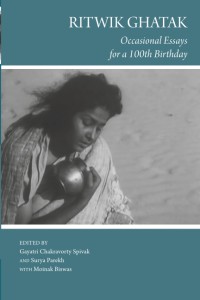

 (0 vote)
Average rating:
| 0 | rating |  = We can do without = We can do without |
| 0 | rating |  = Good book = Good book |
| 0 | rating |  = Excellent book = Excellent book |
| 0 | rating |  = Unique / a reference = Unique / a reference |
Your rating: -
Book Presentation:
A bold, transnational interpretation of Ritwik Ghatak’s cinema that invites readers to encounter his films as meditations on history, migration, and collective survival.
The cinema of Ritwik Ghatak (1925–76) continues to resonate across borders and generations. His films—largely shaped by the 1947 Partition of Bengal and the experience of displacement—probe the fractured human condition through bold formal experimentation, unforgettable soundscapes, and a profound sense of myth and memory. Though his body of work was modest in size, Ghatak’s influence has steadily expanded, securing his place as a major figure in world cinema. This distinctive volume, which marks the centenary of this visionary filmmaker, gathers essays by important scholars and thinkers from around the world.
Moving beyond conventional film criticism and area studies, the collection stages new, transnational encounters with Ghatak’s films—approaching them as world texts, as sonic and visual experiments, and as meditations on migration, collectivity, and social existence.
About the authors:
Gayatri Chakravorty Spivak is university professor in the humanities at Columbia University and the author of many books, including Nationalism and the Imagination, also published by Seagull Books. Spivak was awarded the 2012 Kyoto Prize in Arts and Philosophy and the 2025 Holberg Prize. In 2013, she received the Padma Bhushan, India’s third-highest civilian award.Surya Parekh is assistant professor in the Department of English at Binghamton University. He is the author of Black Enlightenment.
Press Reviews:
"Of all India’s many comparatively unsung directors, Ritwik Ghatak (1926–76) was possibly the most obviously talented. . . . Here was a passionate and intensely national filmmaker who seemed to have found his way without much access to the work of others but who was most certainly of international calibre. Arrogant, overbearing and hopelessly unreliable, he was also much loved and admired as a restless iconoclast whose dreams were never likely to be wholly fulfilled but still worth dreaming in the fractured society which he seemed to epitomise." -- Derek Malcolm, BFI ― Praise for Ritwik Ghatak
"[Ritwik Ghatak’s] films are not cathartic. They speak to the enduring violence that’s caused by forced exile and to the global crises and conflicts—neoliberal economic reform, armed insurgency, civil war, an ongoing refugee crisis, the global war on terror, the global water crisis, authoritarian challenges to democracy—that extend well beyond the subcontinent. These films rattle with and against their subjects, pulping atrocity to find the agonized pith within. Ghatak’s singular filmic vision depicts the implacable, everyday groping toward hope, if not a home, that can and will encumber a life lived in exile." -- Shiv Kotecha, Frieze ― Praise for Ritwik Ghatak
"In portraying the trauma of the loss of homes among refugees from East Pakistan, which recurs in most of his films for instance, he tried to turn it into a metaphor for the universal sense of rootlessness and alienation suffered by individuals and communities." -- Sumanta Banerjee, Countercurrents ― Praise for Ritwik Ghatak
"For Ghatak, it was the loss of subjecthood experienced by a nation’s people, newly divided along arbitrary lines—a condition imposed as the very criterion of claiming a newly conceived citizenship—that became a recurring obsession. Rather than try to dramatize all the physical brutality of Partition, Ghatak sought to understand the violence done to human subjecthood and relations by the machinations of the nation-state as it draws, and redraws, lines on a map. The specificities that ground Ghatak’s films—from matters of Bengal’s history (and the larger history of British colonialism in India), to subtleties of Bengali social hierarchies; from India’s vast cultural trove of mythology, folklore, and music, to their brilliant, if erratic, allusions to Buñuel, Eisenstein, Brecht, and any number of European figures of the avant-garde—are what make them resistant to easy assimilation into Euro-American canons of global art cinema founded upon historicist ideologies." -- Swagato Chakravorty, Los Angeles Review of Books ― Praise for Ritwik Ghatak
See the publisher website: Seagull Books
See the complete filmography of Ritwik Ghatak on the website: IMDB ...
> On a related topic:
Ritwik Ghatak and the Cinema of Praxis (2020)
Culture, Aesthetics and Vision
Subject: Director > Ritwik Ghatak



Where Is Abbas Kiarostami? (2025)
Toward a Postcolonial Film-Philosophy
Subject: Director > Abbas Kiarostami




Strangelove Country (2025)
Science Fiction, Filmosophy, and the Kubrickian Consciousness
Subject: Director > Stanley Kubrick
 Back
Back

