


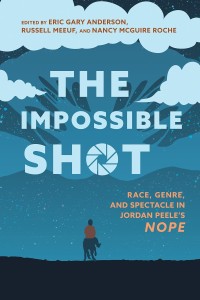
The Impossible Shot
Race, Genre, and Spectacle in Jordan Peele's Nope
Sous la direction de Eric Gary Anderson, Russell Meeuf et Nancy McGuire Roche


 (0 vote)
Moyenne des votes :
| 0 | vote |  = On peut s'en passer = On peut s'en passer |
| 0 | vote |  = Bon livre = Bon livre |
| 0 | vote |  = Excellent livre = Excellent livre |
| 0 | vote |  = Unique / une référence = Unique / une référence |
Votre vote : -
Description de l'ouvrage:
Contributions by Eric Gary Anderson, Hatice Bay, Thomas Britt, Robert Burgoyne, Emily Diane Burkett, Jack Finucane, Adam Hebert, Noemí Fernández Labarga, Russell Meeuf, Wade Newhouse, Isaiah Frost Rivera, Nancy McGuire Roche, Laurent Shervington, Amira Shokr, James Steck, Christy Tidwell, and Lauren Tocci
After the commercial and critical success of 2017’s Get Out, Jordan Peele quickly established himself as an exciting and innovative auteur with a knack for reinventing Hollywood’s genres through the lens of contemporary race relations. With a focus on horror, his films invert the racial preoccupations of an industry that, especially since the mid-2000s, has been fixated on white fears and anxieties. A highly anticipated cinematic event, the release of Nope (2022), Peele’s newest meditation on race, filmmaking, and media spectacle, did not disappoint.
The Impossible Shot: Race, Genre, and Spectacle in Jordan Peele’s “Nope” explores the director's latest film from a variety of perspectives and situates Nope within his larger work, alongside the growing body of scholarship on Peele and the political turn in post-Trump US horror. His third film offered a sprawling, epic, sci-fi, Western, family melodrama focused on those at the margins of Hollywood image making. This collection offers groups of essays organized around three interconnected themes: Nope’s interrogation of media spectacle and the politics of gazing in the social media era; its expansive intertextuality and layers of pop culture referents; and its investment in positioning animals and ecology into a narrative about media and consumption. By teasing out the nuances and complexity of Peele’s work, this volume will appeal to film and media scholars; teachers and students exploring issues of race, media, genre, or Peele as a director; and fans of horror in general.
À propos des auteurs :
Eric Gary Anderson is associate professor of English at George Mason University. His recent work includes contributions to The Cambridge History of Native American Literature; Queering the South on Screen; Small-Screen Souths: Region, Identity, and Cultural Politics of Television in which he holds forth on The X-Files; and PMLA. He is coeditor of Undead Souths: The Gothic and Beyond in Southern Literature and Culture and is currently working on new book projects on the Indigenous undead and on slasher ecologies.Russell Meeuf is professor at the University of Idaho and director of the Film and Television Program there. Among other works, he is author of White Terror: The Horror Film from Obama to Trump. He researches issues of race, gender, and identity in US popular culture, including genre films and celebrity culture.Nancy McGuire Roche is assistant professor of cinema and television studies at Belmont University. Her recent publications include chapters in Modern American Drama on Screen and The Other Hollywood Renaissance. She is coeditor of Conversations with Edmund White, published by University Press of Mississippi.
Revue de Presse:
This collection examines Jordan Peele’s Nope through various critical lenses, engaging with interwoven themes of spectacle, media, technology, genre, race, representation, and the environment, as well as the critical questions they raise regarding exploitation, power, and audience complicity. The essays offer an interdisciplinary and intersectional approach to the film, providing valuable context within Peele’s oeuvre. -- Penelope Ingram, author of Imperiled Whiteness: How Hollywood and Media Make Race in "Postracial" America
Voir le site internet de l'éditeur University Press of Mississippi
Voir la fiche de Nope (2022) sur le site IMDB ...
> Des mêmes auteurs :

Chinese Cinema (2023)
Identity, Power, and Globalization

Projecting the World (2017)
Representing the "Foreign" in Classical Hollywood
Dir. Russell Meeuf et Anna Cooper
Sujet : Sociology


Transnational Stardom (2013)
International Celebrity in Film and Popular Culture
Dir. Russell Meeuf et Raphael Raphael
Sujet : General
> Sur un thème proche :

Star Trek and the Tragic Hybrid (2024)
Children of Two Worlds from Spock to Soji
Sujet : One Film > Star Trek (TV Series)
Dis-Orienting Planets (2021)
Racial Representations of Asia in Science Fiction
Dir. Isiah Lavender
Sujet : Genre > Science Fiction
Black Space (2008)
Imagining Race in Science Fiction Film
de Adilifu Nama
Sujet : Genre > Science Fiction
Pieces of Us (2025)
The Making of Jordan Peele's Modern Horror Classic




I'd Just as Soon Kiss a Wookiee (2025)
Uncovering Racialized Desire in the Star Wars Galaxy
de Greg Carter

Adapting Bridgerton (2024)
Essays on the Netflix Show in Context
Sujet : One Film > Bridgerton (TV Series)
 Retour


