

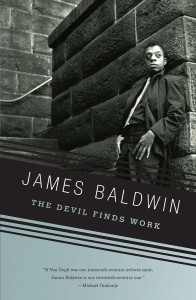
The Devil Finds Work
An Essay


 (0 vote)
Average rating:
| 0 | rating |  = We can do without = We can do without |
| 0 | rating |  = Good book = Good book |
| 0 | rating |  = Excellent book = Excellent book |
| 0 | rating |  = Unique / a reference = Unique / a reference |
Your rating: -
Book Presentation:
From "the best essayist in this country” (The New York Times Book Review) comes an incisive book-length essay about racism in American movies that challenges the underlying assumptions in many of the films that have shaped our consciousness.
Baldwin’s personal reflections on movies gathered here in a book-length essay are also an appraisal of American racial politics. Offering a look at racism in American movies and a vision of America’s self-delusions and deceptions, Baldwin considers such films as In the Heat of the Night, Guess Who’s Coming to Dinner, and The Exorcist.
Here are our loves and hates, biases and cruelties, fears and ignorance reflected by the films that have entertained and shaped us. And here too is the stunning prose of a writer whose passion never diminished his struggle for equality, justice, and social change.
About the Author:
James Baldwin (1924–1987) was a novelist, essayist, playwright, poet, and social critic. His first novel, Go Tell It on the Mountain, appeared in 1953 to excellent reviews, and his essay collections Notes of a Native Son and The Fire Next Time were bestsellers that made him an influential figure in the growing civil rights movement. Baldwin spent much of his life in France, where he moved to escape the racism and homophobia of the United States. He died in France in 1987, a year after being made a Commander of the French Legion of Honor.
Press Reviews:
"If Van Gogh was our 19th-century artist-saint, James Baldwin is our 20th-century one."
—Michael Ondaatje
"The best essayist in this country—a man whose power has always been in his reasoned, biting sarcasm; his insistence on removing layer by layer the hardened skin with which Americans shield themselves from their country."
—The New York Times Book Review
"It will be hard for the reader to see these films in quite the same way again."
—The Christian Science Monitor
"He has taken the old subject of race and made it even more personal probing perhaps more deeply than ever before into American racial practices."
—The Nation
"A provocative discussion."
—Saturday Review
See the publisher website: Vintage Books
> On a related topic:
Black Film (2026)
A History of Black Representation and Participation in the Movies
Subject: Countries > United States
Toms, Coons, Mulattoes, Mammies, and Bucks (2016)
An Interpretive History of Blacks in American Films
by Donald Bogle
Subject: Countries > United States

Reel Freedom (2025)
Black Film Culture in Early Twentieth-Century New York City
by Alyssa Lopez
Subject: Sociology
Sacred Sisterhoods (2025)
A Celebration of Black Women's Friendships on Television and in Film
Dir. Imani M. Cheers
Subject: Sociology
Colorization (2024)
One Hundred Years of Black Films in a White World
by Wil Haygood
Subject: Sociology
 Back
Back