


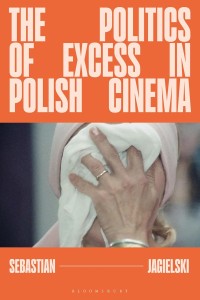
The Politics of Excess in Polish Cinema


 (0 vote)
Average rating:
| 0 | rating |  = We can do without = We can do without |
| 0 | rating |  = Good book = Good book |
| 0 | rating |  = Excellent book = Excellent book |
| 0 | rating |  = Unique / a reference = Unique / a reference |
Your rating: -
Book Presentation:
Departing from standard histories, this book draws on the theory of excess in film to provide a re-examination of Polish cinema history, following emancipatory impulses that emerged in Polish culture between the great crisis of 1968 and the conservative revolution of the Solidarity movement in the 1980s.
Employing a transnational, queer, and decolonial lens, Sebastian Jagielski argues that beyond the binary of state-endorsed and official 'opposition' media, there exists a range of subversive and radical films. He provides close readings of key examples such as The Devil (Diabel) (1972), A Story of Sin (Dzieje grzechu) (1975) and The Palace (Palac) (1980), considering their depiction and transformation of emancipatory ideals born out of Western countercultural movements. He also explores the filmmaking practices of directors like Andrzej Wajda and Andrzej Zulawski, examining their use of subtext, lurid narratives and subversive embedded gestures, all developed against the backdrop of normative visions of Polishness shaped by nationalism, Catholicism, and heteronormativity. In doing so he proposes a critical revision of the conservative cinema of moral anxiety.
The book also addresses how on-screen depictions of sexuality intersect with various modes of difference, highlighting the impact of racism, homophobia, misogyny, and classism. Rejecting a linear narrative in favour of a fragmented history, Jagielski uncovers the untold stories of Polish cinema's subversive influences.
About the Author:
Sebastian Jagielski is Assistant Professor at the Film History Department of the Institute of Audiovisual Arts at the Jagiellonian University. He is the author of Masquerades of Masculinity: Homosocial Desire in Polish Cinema (in Polish, 2013) and Interrupted Emancipations: The Politics of Excess in the Polish Cinema of 1968-1982 (in Polish, 2021). His papers were published i.a. in Studies in Eastern European Cinema and Studies in European Cinema.Lúcia Nagib is Professor of Film and Director of the Centre for Film Aesthetics and Cultures (CFAC) at the University of Reading. Her research has focused, among other subjects, on polycentric approaches to world cinema, new waves and new cinemas, cinematic realism and intermediality. She is the author of World Cinema and the Ethics of Realism (Continuum, 2011), Brazil on Screen: Cinema Novo, New Cinema, Utopia (I.B. Tauris, 2007), The Brazilian Film Revival: Interviews with 90 Filmmakers of the 90s (Editora 34, 2002), Born of the Ashes: The Auteur and the Individual in Oshima's Films (Edusp, 1995), Around the Japanese Nouvelle Vague (Editora da Unicamp, 1993) and Werner Herzog: Film as Reality (EstaçãoLiberdade, 1991). She is the editor of Impure Cinema: Intermedial and Intercultural Approaches to Film (with Anne Jerslev, 2013), Theorizing World Cinema (with Chris Perriam and Rajinder Dudrah, I.B. Tauris, 2011), Realism and the Audiovisual Media (with Cecília Mello, Palgrave, 2009), The New Brazilian Cinema (I.B. Tauris, 2003), Master Mizoguchi (Navegar, 1990) and Ozu (Marco Zero, 1990).Julian Ross is a University Lecturer at the Centre for the Arts in Society.
Press Reviews:
"Sebastian Jagielski's The Politics of Excess in Polish Cinema is a wonderful book – and an important one. On the one hand, it is a thorough and dense study of subversive and radical film in 1970s and 1980s Poland; on the other, it is a plea that, in times like these, there can be no excess of emancipatory forces in art." ―Bernd Herzogenrath, Goethe Universität Frankfurt, Germany
"The Politics of Excess in Polish Cinema boldly subverts the dominant discourse on the history of Polish film, unearthing the emancipatory impulses suppressed by national/ist narratives. Original and rigorous, the monograph is a breakthrough in studies of Polish and Eastern European cinema." ―Elzbieta Ostrowska, University of Lódz, Poland
> On a related topic:
The American Film in the Crisis of Confidence (2025)
Hollywood Malaise, 1976-1983
Subject: Countries > United States
Crosscurrents (2019)
How film policy developed in Quebec 1960-1983

Hope Is of a Different Color (2022)
From the Global South to the Lodz Film School
Dir. Magda Lipska and Monika Talarczyk

Poland Daily (2022)
Economy, Work, Consumption and Social Class in Polish Cinema
Framing the Holocaust in Polish Aftermath Cinema (2022)
Posthumous Materiality and Unwanted Knowledge
by Matilda Mroz
 Back
Back

