

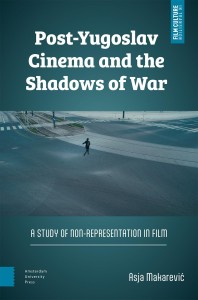
Post-Yugoslav Cinema and the Shadows of War
A Study of Non-Representation in Film


 (0 vote)
Moyenne des votes :
| 0 | vote |  = On peut s'en passer = On peut s'en passer |
| 0 | vote |  = Bon livre = Bon livre |
| 0 | vote |  = Excellent livre = Excellent livre |
| 0 | vote |  = Unique / une référence = Unique / une référence |
Votre vote : -
Description de l'ouvrage:
Bosnia-Herzegovina is still considered a post-war country. The concept of post-war implies that the country and its people are tied more strongly to the past than they are oriented towards the future. Paradoxically, as long as the future is kept at bay and the post-war condition kept alive, Bosnia maintains a certain significance on the global scene. However, living in the temporal vacuum of the post-war condition cannot be a long-term perspective. A range of post-Yugoslav films provides spectators with images that offer innovative approaches to the collective past, while simultaneously reframing contemporary experience. This study proposes to call non-representational images appears to offer a more dynamic relationship to the past and the present, while reflecting complex processes of the formation of identity, memory, guilt, and responsibility. But if these dynamics are inherent in non-representational images, is there a way in which they can contribute to overcoming the post-war condition?
À propos de l'auteur :
Asja Makarevi. is a post-doctoral fellow in the research programme “AGE-C Ageing and Gender in European Cinema” at Goethe University, Frankfurt, where she obtained her PhD degree. She serves as a member of the Berlinale Forum selection committee.
Voir le site internet de l'éditeur Amsterdam University Press
> Sur un thème proche :

Traumatic Imprints (2018)
Cinema, Military Psychiatry, and the Aftermath of War
de Noah Tsika
Sujet : Sociology
Disappearing War (2017)
Interdisciplinary Perspectives on Cinema and Erasure in the Post-9/11 World
Dir. Christina Hellmich et Lisa Purse
Sujet : Sociology
Defeated Masculinity (2009)
Post-Traumatic Cinema in the Aftermath of War
de Raya Morag
Sujet : Sociology
Down Syndrome Culture (2024)
Life Writing, Documentary, and Fiction Film in Iberian and Latin American Contexts
Sujet : Sociology
 Retour