

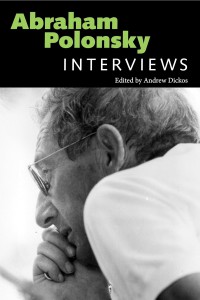
Abraham Polonsky
Interviews
Edited by Andrew Dickos


 (0 vote)
Average rating:
| 0 | rating |  = We can do without = We can do without |
| 0 | rating |  = Good book = Good book |
| 0 | rating |  = Excellent book = Excellent book |
| 0 | rating |  = Unique / a reference = Unique / a reference |
Your rating: -
Book Presentation:
Abraham Polonsky (1910–1999), screenwriter and filmmaker of the mid-twentieth-century Left, recognized his writerly mission to reveal the aspirations of his characters in a material society structured to undermine their hopes. In the process, he ennobled their struggle. His auspicious beginning in Hollywood reached a zenith with his Oscar-nominated screenplay for Robert Rossen's boxing noir film, Body and Soul (1947), and his inaugural film as writer and director, Force of Evil (1948), before he was blacklisted during the McCarthy witch hunt.
Polonsky envisioned cinema as a modern artist. His aesthetic appreciation for each technical component of the screen aroused him to create voiceovers of urban cadences—poetic monologues spoken by the city's everyman, embodied by the actor who played his heroes best, John Garfield. His use of David Raksin's score in Force of Evil, against the backdrop of the grandeur of New York City's landscape and the conflict between the brothers Joe and Leo Morse, elevated film noir into classical family tragedy.
Like Garfield, Polonsky faced persecution and an aborted career during the blacklist. But unlike Garfield, Polonsky survived to resume his career in Hollywood during the ferment of the late sixties. Then his vision of a changing society found allegorical expression in Tell Them Willie Boy Is Here, his impressive anti-Western showing the destruction of the Paiute rebel outsider, Willie Boy, and cementing Polonsky as a moral voice in cinema.
About the Author:
Andrew Dickos is author of Street with No Name: A History of the Classic American Film Noir; Intrepid Laughter: Preston Sturges and the Movies; and Honor Among Thieves: The Cinema of Jean-Pierre Melville. He is a commentator on Paramount Home Entertainment’s DVD of Preston Sturges’s The Miracle of Morgan’s Creek and the contributor on film noir to the Columbia World of Quotations.
See the publisher website: University Press of Mississippi
See the complete filmography of Abraham Polonsky on the website: IMDB ...
> From the same author:
Street with No Name (2021)
A History of the Classic American Film Noir
Honor Among Thieves (2021)
The Cinema of Jean-Pierre Melville
Subject: Director > Jean-Pierre Melville
Street with No Name (2013)
A History of the Classic American Film Noir
> On a related topic:
Sydney Pollack (2026)
Collected Interviews
Dir. Patrick McGilligan and Paul Cronin
Subject: Director > Sydney Pollack
Krzysztof Kieślowski (2024)
Interviews
Dir. Renata Bernard and Steven Woodward
Subject: Director > Krzysztof Kieslowski
D. A. Pennebaker (2024)
Interviews
Dir. Keith Beattie and Trent Griffiths
Subject: Director > D.A. Pennebaker

 Back
Back

