

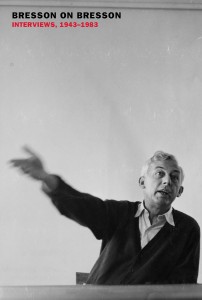
Bresson on Bresson
Interviews, 1943-1983


 (0 vote)
Average rating:
| 0 | rating |  = We can do without = We can do without |
| 0 | rating |  = Good book = Good book |
| 0 | rating |  = Excellent book = Excellent book |
| 0 | rating |  = Unique / a reference = Unique / a reference |
Your rating: -
Book Presentation:
Now in paperback, a collection of interviews with a French cinematic titan—covering subjects such as adaptation, the effects of capitalism on art, and the importance of intuition—selected from a period of four decades.
Robert Bresson, the director of such cinematic masterpieces as Pickpocket, A Man Escaped, Mouchette, and L’Argent, was one of the most influential directors in the history of French film, as well as one of the most stubbornly individual: He insisted on the use of nonprofessional actors; he shunned the “advances” of Cinerama and CinemaScope (and the work of most of his predecessors and peers); and he minced no words about the damaging influence of capitalism and the studio system on the still-developing—in his view—art of film.
Bresson on Bresson collects the most significant interviews that Bresson gave (carefully editing them before they were released) over the course of his forty-year career to reveal both the internal consistency and the consistently exploratory character of his body of work.
Successive chapters are dedicated to each of his fourteen films, as well as to the question of literary adaptation, the nature of the soundtrack, and to Bresson’s one book, the great aphoristic treatise Notes on the Cinematograph. Throughout, his close and careful consideration of his own films and of the art of film is punctuated by such telling mantras as “Sound...invented silence in cinema,” “It’s the film that...gives life to the characters—not the characters that give life to the film,” and (echoing the Bible) “Every idle word shall be counted.”
Bresson’s integrity and originality earned him the admiration of younger directors from Jean-Luc Godard and Jacques Rivette to Olivier Assayas. And though Bresson’s movies are marked everywhere by an air of intense deliberation, these interviews show that they were no less inspired by a near-religious belief in the value of intuition, not only that of the creator but that of the audience, which he claims to deeply respect: “It’s always ready to feel before it understands. And that’s how it should be.”
About the Author:
Robert Bresson (1901–1999) directed over a dozen films over his lifetime, many of them regarded as masterpieces, including Diary of a Country Priest, A Man Escaped, Mouchette, Au hasard Balthazar, Pickpocket, Lancelot of the Lake, and L’Argent. Throughout his career Bresson eschewed the use of theatrical techniques and employed nonprofessional actors, whom he referred to as models. Raised in the Catholic faith, he worked on and off throughout his career on an adaptation of the book of Genesis, which never saw fruition. New York Review Books also publishes Bresson’s celebrated Notes on the Cinematograph.Anna Moschovakis is a translator and editor and the author of several books, including, most recently, the poetry collection They and We Will Get into Trouble For This and the novels Eleanor: Or, the Rejection of the Possibility of Love and Participation.Mylène Bresson is Robert Bresson’s widow and the manager of his estate.Pascal Mérigeau is a journalist and film critic who has published numerous books, among them biographies of Joseph L. Mankiewicz, Maurice Pialat, and Jean Renoir.
Press Reviews:
"We are still coming to terms with Robert Bresson, and the peculiar power and beauty of his films."
—Martin Scorsese
"The collection Bresson on Bresson: Interviews 1943-1983 and Bresson's own Notes on the Cinematograph are primers for the gradual understanding of Robert Bresson, to paraphrase Gertrude Stein...The interviews in Bresson on Bresson are grouped chronologically and organized by film. Reading it, one can see Bresson refining his answers to the similar questions that inevitably arose with each new production, even as he refined his filmmaking style." —J. Hoberman, The New York Times
"Bresson was the only director who knew how to captivate and surprise me. I consider him a unique phenomenon in the world of film." —Andrei Tarkovsky
"Bresson’s characters, his movies, and Bresson himself all become icons. . . . Bresson has transcended himself: he is blazed in mosaics in some moss-grown temple." —Paul Schrader
"The power of Bresson's...films lies in the fact that his purity and fastidiousness are not just an assertion about the resources of the cinema, as much of modern painting is mainly a comment in paint about painting. They are at the same time an idea about life, about what Cocteau called 'inner style,' about the most serious way of being human." —Susan Sontag
"Cinephiles will delight in reading this book and following Bresson’s thinking as it develops further and makes each interview more compelling than the last." —Publishers Weekly
"To not get Bresson is to not get the idea of motion pictures--it's to have missed that train the Lumiére brothers filmed arriving at Lyon station 110 years ago." —J. Hoberman, The Village Voice
"Robert Bresson's 13 features over 40 years constitute arguably the most original and brilliant body of work over a long career from a film director in the history of cinema. He is the most idiosyncratic and uncompromising of all major filmmakers." —Alan Pavelin, Senses of Cinema
See the publisher website: New York Review Books
See the complete filmography of Robert Bresson on the website: IMDB ...
> From the same author:
> On a related topic:
Late Bresson and the Visual Arts (2018)
Cinema, Painting and Avant-Garde Experiment
Subject: Director > Robert Bresson
The Bond of the Furthest Apart (2017)
Essays on Tolstoy, Dostoevsky, Bresson, and Kafka
Subject: Director > Robert Bresson
Neither God Nor Master (2011)
Robert Bresson and Radical Politics
by Brian Price
Subject: Director > Robert Bresson
Five French Filmmakers (2008)
Renoir, Bresson, Tati, Truffaut, Rohmer: Essays and Interviews
Subject: Director > Jean Renoir, Robert Bresson, Jacques Tati, François Truffaut, Eric Rohmer
 Back
Back

