


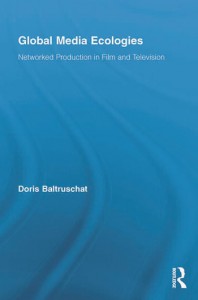
Global Media Ecologies
Networked Production in Film and Television


 (0 vote)
Average rating:
| 0 | rating |  = We can do without = We can do without |
| 0 | rating |  = Good book = Good book |
| 0 | rating |  = Excellent book = Excellent book |
| 0 | rating |  = Unique / a reference = Unique / a reference |
Your rating: -
Book Presentation:
In this study, Baltruschat calls attention to dramatic changes in worldwide media production. Her work provides new insights into industry re-organization, digital media, and audience interactivity as pivotal relationships are redrawn along the entire value chain of production, distribution, and consumption. Based on an international study, she details how cultural agents now negotiate a media landscape through collaborative ventures, co-productions and format franchising. These varied collaborations define the new global media economy and affect a shift across the entire field of cultural production.
Through detailing the intricacies of globally networked production ecologies, Baltruschat elucidates the shifting power relations in media production, especially in regards to creative labor and trade of intellectual properties. In the new global economy, "content" has become the "new currency." As a result, relational dynamics between cultural agents emerge as key forces in shaping worldwide cultural production, now increasingly characterized by flexible production and consumption.
The blurring of lines in international media developments require new parameters, which define creativity and intellectual property in relation to interactive audiences and collaboratively produced content. Baltruschat clearly maps and defines these new dynamics and provides solutions as to how creative labor constellations can advance and enrich the new media economy. This is especially pertinent as global film and TV production does not necessarily result in greater media diversity. On the contrary, interdependencies in policy regimes, prioritization of certain genres, and branded entertainment epitomize how current networked ecologies reflect broader trends in cultural and economic globalization.
About the Author:
Doris Baltruschat is a media and communications scholar with extensive experience in film and television production and distribution, and a former instructor at the School of Journalism and Communication at Carleton University.
See the publisher website: Routledge
> From the same author:
Independent Filmmaking Around the Globe (2015)
Dir. Doris Baltruschat and Mary P. Erickson
Subject: Genre > Independent cinema
> On a related topic:



Filmonomics (2025)
Economists Discuss the Silver Screen
Dir. André de Palma and Luc Leruth
Subject: Economics
Television's Second Golden Age (2025)
Politics and International Relations in the Era of HBO and Streaming TV
Subject: Economics
Global Development of Asian Cinema in the Film Industry (2025)
Dir. Changsong Wang, Cheng Fei Yong and Rustono Farady Marta
Subject: Economics
Micro-Budget Methods of Cinematic Storytelling (2025)
A Practical Guide to Making Narrative Media with Minimal Means
by Jake Mahaffy
Subject: Economics
 Back
Back

