


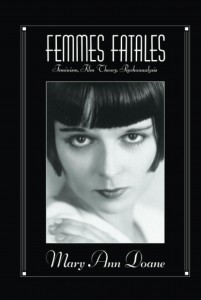
Femmes Fatales


 (0 vote)
Average rating:
| 0 | rating |  = We can do without = We can do without |
| 0 | rating |  = Good book = Good book |
| 0 | rating |  = Excellent book = Excellent book |
| 0 | rating |  = Unique / a reference = Unique / a reference |
Your rating: -
Book Presentation:
In this work of feminist film criticism, Mary Ann Doane examines questions of sexual difference and knowledge in cinematic, theoretical, and psychoanalytic discourses. "Femmes Fatales" examines Freud, the female spectator, the meaning of the close-up, and the nature of stardom. Doane's analyses of such figures as Pabst's Lulu and Rita Hayworth's Gilda trace the thematics and mechanics of maskes, masquerade, and veiling, with specific attention to the form and technology of the cinema. Working through and against the intellectual frameworks of post-structuralist and psychoanalytic theory, Doane interrogates cinematic and theoretical claims to truth about women which rely on judgements about vision and its stability or instability. Reflecting the shift in conceptual priorities within feminist film theory over the last decade, "Femmes Fatales" addresses debates over female spectatorhsip, essentialism and anti-essentialism, the tensions between psychoanalysis and history, and the relations between racial and sexual difference. Doane's nuanced and original readings of the "femme fatale" in cinema illustrate confrontations between feminism, film theory and psychoanalysis. This book should be of interest to students and lecturers in women's studies, communications studies and film theory.
Press Reviews:
"Doane's insights into the ways in which women's bodies become a cinematic battleground are startling and illuminating. Likewise, her lengthy essays on psychoanalysis and racial difference and on the relationship between Freudian concept of sublimation and aesthetics (both written for this volume) are lucid and provocative, challenging the assumption that both race and aesthetics lie outside the purview of psychoanalysis." -- Publishers Weekly
See the publisher website: Routledge
> From the same author:

> On a related topic:

Feminist Visions (2026)
Tracing Feminist Epistemologies in Contemporary Film and Television
Dir. Hélène Charlery and Cristelle Maury
Subject: Sociology


Ambiguous Cinema (2024)
From Simone de Beauvoir to Feminist Film-Phenomenology
by Kelli Fuery
Subject: Sociology
Sustainable Resilience in Women's Film and Video Organizations (2024)
A Counter-Lineage in Moving Image History
Subject: Sociology
Incomplete (2023)
The Feminist Possibilities of the Unfinished Film
Dir. Alix Beeston and Stefan Solomon
Subject: Sociology
 Back
Back

