

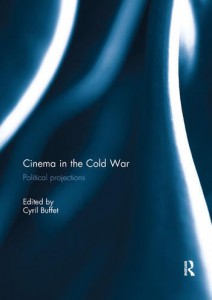
Cinema in the Cold War
Political Projections
Sous la direction de Cyril Buffet


 (0 vote)
Moyenne des votes :
| 0 | vote |  = On peut s'en passer = On peut s'en passer |
| 0 | vote |  = Bon livre = Bon livre |
| 0 | vote |  = Excellent livre = Excellent livre |
| 0 | vote |  = Unique / une référence = Unique / une référence |
Votre vote : -
Description de l'ouvrage:
The film industry was an important propaganda element during the Cold War. As with other conflicts, the Cold War was fought not just with weapons, but with words and images. Throughout the conflict, cinema was a reflection of the societies, the ideologies, and the political climates in which the films were produced. On both sides, great stars, major companies, famous scriptwriters, and filmmakers were enlisted to help the propaganda effort.
It was not only propaganda that was created by the cinema of the Cold War – it also articulated criticism, and the movie industries were centres of the fabrication of modern myths. The cinema was undoubtedly a place of Cold War confrontation and rivalry, and yet there were aesthetic, technical, narrative exchanges between West and East. All genres of film contributed to the Cold War: thrillers, westerns, comedies, musicals, espionage films, documentaries, cartoons, science fiction, historical dramas, war films, and many more. These films shaped popular culture and national identities, creating vivid characters like James Bond, Alec Leamas, Harry Palmer, and Rambo. While the United States and the Soviet Union were the two main protagonists in this on-screen duel, other countries, such as Britain, Germany, Poland, Italy, and Czechoslovakia, also played crucially important parts, and their prominent cinematographic contributions to the Cold War are all covered in this volume. This book was originally published as a special issue of Cold War History.
À propos de l'auteur :
Cyril Buffet is a historian specialising in international relations and German history. He is director of studies at SFiB (Berlin), Germany. He has taught at universities in France, Germany, and the UK, and has curated historical exhibitions and authored TV documentaries on a variety of cultural topics.
> Sur un thème proche :
World Socialist Cinema (2023)
Alliances, Affinities, and Solidarities in the Global Cold War
Sujet : Sociology
Media and the Cold War in the 1980s (2018)
Between Star Wars and Glasnost
Dir. Henrik G. Bastiansen, Martin Klimke et Rolf Werenskjold
Sujet : Sociology

Insurgent Media from the Front (2020)
A Media Activism Reader
Dir. Chris Robé et Stephen Charbonneau
Sujet : Sociology
Film Propaganda and American Politics (2015)
An Analysis and Filmography
de James Combs et Sara T. Combs
Sujet : Sociology
Projecting Politics (2015)
Political Messages in American Films
de Elizabeth Haas, Terry Christensen et Peter J. Haas
Sujet : Sociology
Film Criticism, the Cold War, and the Blacklist (2014)
Reading the Hollywood Reds
de Jeff Smith
Sujet : History of Cinema
The Bondian Cold War (2024)
The Transnational Legacy of a Cultural Icon
Dir. Martin D. Brown, Ronald J. Granieri et Muriel Blaive
Sujet : One Film > James Bond
Policing Show Business (2024)
J. Edgar Hoover, the Hollywood Blacklist, and Cold War Movies
Sujet : Countries > United States
 Retour