

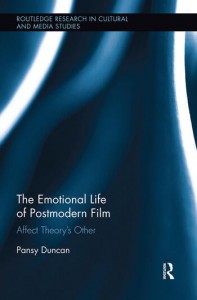
The Emotional Life of Postmodern Film
Affect Theory's Other
by Pansy Duncan


 (0 vote)
Average rating:
| 0 | rating |  = We can do without = We can do without |
| 0 | rating |  = Good book = Good book |
| 0 | rating |  = Excellent book = Excellent book |
| 0 | rating |  = Unique / a reference = Unique / a reference |
Your rating: -
Book Presentation:
Emotion and Postmodernism: is it possible to imagine an odder couple, stranger bedfellows, less bad company? The Emotional Life of Postmodern Film brings this unlikely pair into sustained dialogue, arguing that the interdisciplinary body of scholarship currently emerging under the rubric of "affect theory" may be unexpectedly enriched by an encounter with the field that has become its critical other. Across a series of radical re-reappraisals of canonical postmodern texts, from Fredric Jameson's Postmodernism to David Cronenberg's Crash, Duncan shows that the same postmodern archive that has proven resistant to strongly subject-based and object-oriented emotions, like anger and sadness, proves all too congenial to a series of idiosyncratic, borderline emotions, from knowingness, fascination and bewilderment to boredom and euphoria. The analysis of these emotions, in turn, promises to shake up scholarly consensus on two key counts. On the one hand, it will restructure our sense of the place and role of emotion in a critical enterprise that has long cast it as the stodgy, subjective sister of a supposedly more critically interesting and politically productive affect. On the other, it will transform our perception of postmodernism as a now-historical aesthetic and theoretical moment, teaching us to acknowledge more explicitly and to name more clearly the emotional life that energizes it.
About the Author:
Pansy Duncan is Lecturer in the School of English and Media Studies at Massey University, Auckland, New Zealand, where she writes on media affect and aesthetics. Her articles have been published in a range of venues, including PMLA, Cultural Critique, Textual Practice, Screen, and Film Quarterly.
See the publisher website: Routledge
> From the same author:
Screening the Posthuman (2023)
by Missy Molloy, Pansy Duncan and Claire Henry
> On a related topic:
Fictions Inc. (2014)
The Corporation in Postmodern Fiction, Film, and Popular Culture
by Ralph Clare
Subject: Sociology
Blossoms and Blood (2013)
Postmodern Media Culture and the Films of Paul Thomas Anderson
by Jason Sperb
Subject: Director > Paul Thomas Anderson

Crossing New Europe (2006)
Postmodern Travel and the European Road Movie
by Ewa Mazierska and Laura Rascaroli
 Back
Back

