

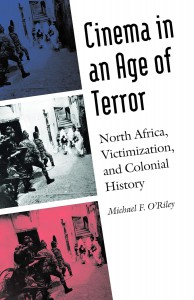
Cinema in an Age of Terror
North Africa, Victimization, and Colonial History


 (0 vote)
Average rating:
| 0 | rating |  = We can do without = We can do without |
| 0 | rating |  = Good book = Good book |
| 0 | rating |  = Excellent book = Excellent book |
| 0 | rating |  = Unique / a reference = Unique / a reference |
Your rating: -
Book Presentation:
Cinema in an Age of Terror looks at how cinematic representations of colonial-era victimization inform our understanding of the contemporary age of terror. By examining works representing colonial history and the dynamics of spectatorship emerging from them, Michael F. O’Riley reveals how the centrality of victimization in certain cinematic representations of colonial history can help us understand how the desire to occupy the victim’s position is a dangerous and blinding drive that frequently plays into the vision of terrorism.
Films such as The Battle of Algiers, Days of Glory, Caché, and recent works by Maghrebien filmmakers all exemplify, in different ways, how this focus on victimization can become a problematic perspective—one in fact seeking to occupy ideological territory. Their return of colonial history to our contemporary context, although frequently problematic, enables us to see how victimization is very much about territory—cultural, spatial, and ideological—and how resistance to new forms of imperialist warfare and terror today must be located outside these haunting images from colonial history. Although such images of victimization ultimately only return as spectacular acts that draw our attention away from the cyclical contest over territory that they embody, those images nonetheless have the last word.
Michael F. O’Riley is an associate professor of French and Italian at Colorado College. He is the author of Francophone Culture and the Postcolonial Fascination with Ethnic Crimes and Colonial Aura and Postcolonial Haunting and Victimization: Assia Djebar’s New Novels.
About the Author:
Michael F. O’Riley is an associate professor of French and Italian at Colorado College. He is the author of Francophone Culture and the Postcolonial Fascination with Ethnic Crimes and Colonial Aura and Postcolonial Haunting and Victimization: Assia Djebar’s New Novels.
Press Reviews:
"A very thoughtful book which deserves to be read both widely and attentively."—Philip Dine, H-France Review
> On a related topic:

Palimpsestic Memory (2015)
The Holocaust and Colonialism in French and Francophone Fiction and Film
Cinema, Colonialism, Postcolonialism (1996)
Perspectives from the French and Francophone Worlds
Dir. Dina Sherzer
Performing the Cold War in the Postcolonial World (2024)
Theatre, Film, Literature and Things
Dir. Christopher B. Balme
Subject: Sociology
Celluloid Colony (2021)
Locating History and Ethnography in Early Dutch Colonial Films of Indonesia
by Sandeep Ray
Subject: Sociology
Cinematic Settlers (2020)
The Settler Colonial World in Film
Dir. Janne Lahti and Rebecca Weaver-Hightower
Subject: Sociology
Films for the Colonies (2019)
Cinema and the Preservation of the British Empire
by Tom Rice
Subject: Sociology
 Back
Back