


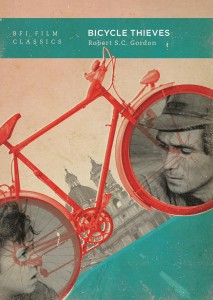
Bicycle Thieves


 (0 vote)
Average rating:
| 0 | rating |  = We can do without = We can do without |
| 0 | rating |  = Good book = Good book |
| 0 | rating |  = Excellent book = Excellent book |
| 0 | rating |  = Unique / a reference = Unique / a reference |
Your rating: -
Book Presentation:
Vittorio De Sica's Bicycle Thieves (Ladri di biciclette, 1948) is unarguably one of the most important films in the history of cinema. It is also one of the most beguiling, moving, and seemingly simple works of narrative ever made. The film tells the story of one man and his son as they search fruitlessly through the streets of Rome for his stolen bicycle; the bicycle which had offered the possibility of escape from the poverty and humiliation of long-term unemployment.
One of a cluster of extraordinary films to come out of post-war, post-Fascist Italy, loosely labelled 'neorealist', Bicycle Thieves won an Oscar in 1950, topped the first Sight and Sound poll of the best films of all time in 1952 and has been hugely influential throughout world cinema ever since. It remains a necessary point of reference for any cinematic engagement with the labyrinthine experience of the modern city, the travails of poverty in the contemporary world, the complex bond between fathers and sons, and the capacity of the camera to capture something like the essence of all of these.
Robert S. C. Gordon's study shows how Bicycle Thieves is ripe for re-viewing, for rescuing from its worthy status as a neorealist 'classic'. It looks at the film's drawn-out planning and production, the vibrant and riven historical moment in which it was made, and the dynamic geography, geometry and sociology of the film that resulted.
In his afterword to this new edition, Gordon assesses the film's enduring resonance, close to eighty years after its release, and its potential to help us understand precarity and care in our troubled present day.
About the Author:
Robert S.C. Gordon is Head of Department of Italian, Professor of Modern Italian Culture, and Fellow of Gonville and Caius College, University of Cambridge, UK. His publications include Primo Levi's Ordinary Virtues, The Cambridge Companion to Primo Levi, The Holocaust in Italian Culture, 1944-2010, and on cinema, Pasolini: Forms of Subjectivity. He is co-editor of Culture, Censorship and the State in 20th-Century Italy.
See the publisher website: BFI Publishing
See Bicycle Thieves (1948) on IMDB ...
> On a related topic:

Realist Film Theory and Bicycle Thieves (2023)
by Hilary Neroni and Todd McGowan
Subject: One Film > Bicycle Thieves
Vittorio De Sica (2000)
Contemporary Perspectives
Dir. Howard Curle and Stephen Snyder
Subject: Director > Vittorio De Sica
 Back
Back

