


Watching Cosmic Time
The Suspense Films of Hitchcock, Welles, and Reed

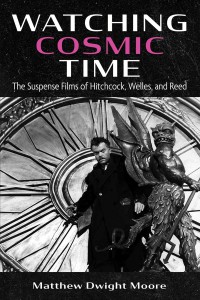

 (0 vote)
Average rating:
| 0 | rating |  = We can do without = We can do without |
| 0 | rating |  = Good book = Good book |
| 0 | rating |  = Excellent book = Excellent book |
| 0 | rating |  = Unique / a reference = Unique / a reference |
Your rating: -
Book Presentation:
How do the suspense films of Alfred Hitchcock, Orson Welles, and Carol Reed allow us special insight into the popular mentality of their contemporaries—contemporaries who went to war against the forces of Adolf Hitler? How did midcentury films that fetishized clocks and time-keeping devices as diverse as Peter Pan, High Noon, Rear Window, Shadow of a Doubt, The Stranger, and Odd Man Out produce unique experiences that invited audiences to literally watch cosmic time? What role did cinema audiences play in perpetuating the presumption that order exists in the universe—and how have the polyvalent institutions of church and state implicated human agency in such perpetuation? This full-length academic treatment of the topic employs formal film analysis that is situated squarely within historical studies and addresses these cinematic and phenomenological questions—and more.
About the Author:
Matthew Dwight Moore is associate professor of humanities at the Roberts Wesleyan College in Rochester, New York and recipient of a 2020 National Endowment for the Humanities grant. He has written in Silence and the Silenced: Interdisciplinary Perspectives (2013), Earnest: Interdisciplinary Work Inspired by the Life and Teachings of B.T. Roberts (2017), and Afterimage: The Journal of Media Arts and Cultural Criticism (2016-17). His poetry has been published in High Shelf Press and Prometheus Dreaming.
Press Reviews:
"Moore convincingly argues that cinema in the forties and fifties perpetuated the presumption that the universe is fundamentally orderly. He focuses engagingly on suspense films that incorporate clocks in a way that allows the audience to literally watch time as an emblem of an orderly universe. Moore's overall purpose, though, is to encourage us to reflect on the role time plays in how we access, interpret, and respond to what we experience."
--David Basinger, Roberts Wesleyan College
"This insightful study of postwar cinema considers how visual and audio elements in suspense films attended to the passing of time. Watching time was emblematic of order under stress from war and its aftermath. Thoroughly attentive to the details of his cinematic texts, Matthew Moore convincingly argues that filmic worldviews and geopolitical events intersected as suspense films explored moral decision-making and the paradoxes of power. Highly recommended."
--Stanley C. Pelkey, University of Kentucky School of Music
"Moore's exploration of key mid-twentieth-century films against the backdrop of World War II and the problem of order versus chaos is a tour de force of insightful analysis. His attentiveness to clocks and time references in these films made me want to go back and watch them again. Moore's thick description of the geopolitical backdrop of the movies draws the reader in to reflect on how the anxieties of the mid-twentieth century are still with us today."
--J. Richard Middleton, Northeastern Seminary, Roberts Wesleyan College
"This book's greatest strength is Moore's attention to the humanities writ large as he deftly interweaves disciplines ranging from the geopolitics of modern European history to theology and religious allegory as underpinnings for his discussion of these films' presentations of cosmic and metachronic time. This strategy provides both rich context and a compelling vision for how these works from cinema history correlate to the frisson of the contemporary film-viewing experience--from making meaning to the power of personal agency."
--Karen (Ren) vanMeenen, editor, Afterimage
See the publisher website: Cascade Books
See the complete filmography of Alfred Hitchcock on the website: IMDB ...
> On a related topic:
Peter Bogdanovich (2017)
Interviews
Dir. Peter Tonguette
Subject: Director > Orson Welles, Alfred Hitchcock, John Ford, Peter Bogdanovich
The Extraordinary Image (2016)
Orson Welles, Alfred Hitchcock, Stanley Kubrick, and the Reimagining of Cinema
Subject: Director > Orson Welles, Alfred Hitchcock, Stanley Kubrick
The Architecture of Suspense (2022)
The Built World in the Films of Alfred Hitchcock
Subject: Director > Alfred Hitchcock
Partners in Suspense (2016)
Critical Essays on Bernard Herrmann and Alfred Hitchcock
Dir. Steven Rawle and Kevin J. Donnelly
Subject: Director > Alfred Hitchcock
The Suspense Thriller (2001)
Films in the Shadow of Alfred Hitchcock
Acting and performance in Hitchcock (2026)
Dir. Adrian Garvey and Victoria Lowe
Subject: Director > Alfred Hitchcock
 Back
Back

