


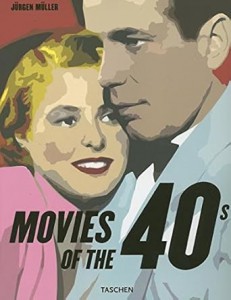
Movies of the 40s
Edited by Jürgen Müller


 (0 vote)
Average rating:
| 0 | rating |  = We can do without = We can do without |
| 0 | rating |  = Good book = Good book |
| 0 | rating |  = Excellent book = Excellent book |
| 0 | rating |  = Unique / a reference = Unique / a reference |
Your rating: -
Book Presentation:
A trendsetting decade in world cinema The 40s were the decade of the movies. With the world at war, directors served up propaganda and escapist entertainment to the massed moviegoers of the pre-television age. Yet in many countries, there was also a parallel tendency towards greater realism. In Italy, for example, the spirit of the resistance culminated in the neorealist movement, which inspired the world's moviemakers with masterpieces such as De Sica's Bicycle Thieves (1948). In Hollywood, the 40s were probably the most creative phase in the studios? history. Never before had the Dream Factory brought such compellingly edgy and experimental films to the silver screen. The most seminal work of the decade was Citizen Kane (1941); Orson Welles's extravagantly original debut anticipated the expressive visual style that would come to typify film noir?the genre of ?dark movies, ? populated by romantic antiheroes and femmes fatales, that still represents the essence of cinema for many passionate movie buffs. In the atmospheric black-and-white universe of noir, Rita Hayworth, Ava Gardner, and Lauren Bacall became timeless erotic icons, while Bogart?following The Big Sleep (1945)?was the very quintessence of cool. While these movies bore witness to the cracks in America's fa?ade, another genre was busily reconstituting the nation's identity. In the films of John Ford, the Western came back with a vengeance, Monument Valley embodied America's incomparable grandeur, and John Wayne (The Duke) was a natural aristocrat of the wild frontier.
About the Author:
The editor: Jürgen Müller studied art history in Bochum, Paris, Pisa, and Amsterdam. He has worked as an art critic, a curator of numerous exhibitions, a visiting professor at various universities, and has published books and numerous articles on cinema and art history. Currently he holds the chair for art history at the University of Dresden, where he lives. Müiler is the series editor for TASCHENs Movies decade titles.
See the publisher website: Taschen
> From the same author:







100 All-Time Favorite Movies of the 20th Century (2015)
Dir. Jürgen Müller
Subject: On Films > Film selections

> On a related topic:
Angels and Ministers of Grace Defend Us! (2022)
More Dark Alleys of Classic Horror Cinema
Film Professionals in Nazi-Occupied Europe (2021)
Mediation Between the National-Socialist Cultural “New Order” and Local Structures
Dir. Pavel Skopal and Roel Vande Winkel
Subject: On Films > Per period
What Dreams Were Made Of (2011)
Movie Stars of the 1940s
Dir. Sean Griffin
Subject: On Films > Per period
Best Years (2009)
Going to the Movies, 1945-1946
by Charles Affron and Mirella Jona Affron
Subject: On Films > Per period
We'll Always Have the Movies (2006)
American Cinema During World War II
by Robert L. McLaughlin and Sally E. Parry
Subject: On Films > Per period
Forties Film Talk (1992)
Oral Histories of Hollywood, with 120 Lobby Posters
Subject: On Films > Per period
Movie Stars of the '40s (1985)
A complete reference guide for the film historian or trivia buff
by David Ragan
Subject: On Films > Per period
 Back
Back

