


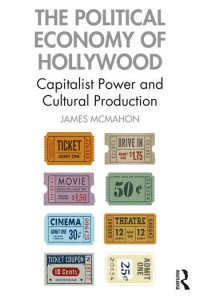
The Political Economy of Hollywood
Capitalist Power and Cultural Production


 (0 vote)
Moyenne des votes :
| 0 | vote |  = On peut s'en passer = On peut s'en passer |
| 0 | vote |  = Bon livre = Bon livre |
| 0 | vote |  = Excellent livre = Excellent livre |
| 0 | vote |  = Unique / une référence = Unique / une référence |
Votre vote : -
Description de l'ouvrage:
In Hollywood, the goals of art and business are entangled. Directors, writers, actors, and idealistic producers aspire to make the best films possible. These aspirations often interact with the dominant firms that control Hollywood film distribution. This control of distribution is crucial as it enables the firms and other large businesses involved, such as banks that offer financing, to effectively stand between film production and the market. This book analyses the power structure of the Hollywood film business and its general modes of behaviour. More specifically, the work analyses how the largest Hollywood firms attempt to control social creativity such that they can mitigate the financial risks inherent in the art of filmmaking.
Controlling the ways people make or watch films, the book argues, is a key element of Hollywood’s capitalist power. Capitalist power—the ability to control, modify, and, sometimes, limit social creation through the rights of ownership—is the foundation of capital accumulation. For the Hollywood film business, capitalist power is about the ability of business concerns to set the terms that will shape the future of cinema. For the major film distributors of Hollywood, these terms include the types of films that will be distributed, the number of films that will be distributed, and the cinematic alternatives that will be made available to the individual moviegoer. Combining theoretical analysis with detailed empirical research on the financial performance of the major Hollywood film companies, the book details how Hollywood’s capitalist goals have clashed with the aesthetic potentials of cinema and ultimately stymied creativity in the pursuit of limiting risk.
This sharp critique of the Hollywood machine provides vital reading for students and scholars of political economy, political theory, film studies, and cinema.
À propos de l'auteur :
James McMahon currently teaches at the University of Toronto, Canada. His main research interests are the Hollywood film business, New Hollywood cinema, social theories of mass culture, political economic theory, and the relationship between institutional power and cultural practices.
> Sur un thème proche :
Hollywood Remaking (2024)
How Film Remakes, Sequels, and Franchises Shape Industry and Culture
Sujet : Economics


Play It Again, Sam (2022)
Retakes on Remakes
Dir. Andrew Horton et Stuart Y. McDougal
Sujet : Economics
Hollywood's Embassies (2022)
How Movie Theaters Projected American Power Around the World
de Ross Melnick
Sujet : Economics

Hollywood Shutdown (2021)
Production, Distribution, and Exhibition in the Time of COVID
Sujet : Economics
Movie Money (2020)
understanding Hollywood's (creative) accounting practices
de Bill Daniels, David Leedy, Steven D. Sills et Peter Klass
Sujet : Economics
 Retour

