


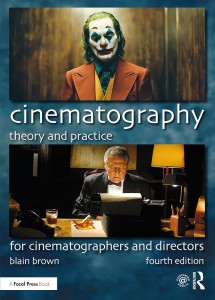
Cinematography
Theory and Practice: For Cinematographers and Directors (livre en anglais)
de Blain Brown


 (0 vote)
Moyenne des votes :
| 0 | vote |  = On peut s'en passer = On peut s'en passer |
| 0 | vote |  = Bon livre = Bon livre |
| 0 | vote |  = Excellent livre = Excellent livre |
| 0 | vote |  = Unique / une référence = Unique / une référence |
Votre vote : -
Description de l'ouvrage :
This book covers both the artistry and craftsmanship of cinematography and visual storytelling. Few art forms are as tied to their tools and technology as is cinematography. Take your mastery of these new tools, techniques, and roles to the next level with this cutting-edge roadmap from author and filmmaker Blain Brown.
This 4th edition has been thoroughly updated throughout to include detailed information on the latest lighting and camera equipment, as well as expanded and updated discussion on the following areas: shooting on a budget, color spaces with emphasis on the new UHD standards, the decision-making process in choosing what lights and equipment to use, considerations concerning power issues, safety and what electrical supply is needed for various types of lights, an examination of the cinematographer’s role in preproduction, and much more.
Topics Include:
• Visual storytelling
• Continuity and coverage
• Cameras and digital sensors
• The tools and basics of film lighting
• Methods of shooting a scene
• Continuity and coverage
• Exposure
• Color
• Understanding digital images
• Using linear, gamma, and log video
• Image control and grading on the set
• Data management and the DIT
• Optics and focus
• Camera movement
• Set operations
• Green screen, high speed, and other topics.
Whether you are a student of filmmaking, someone just breaking into the business, working in the field and looking to move up the ladder, or an experienced filmmaker updating your knowledge of tools and techniques, this book provides both the artistic background of visual language and also the craft of shooting for continuity, lighting tools and methods, and the technical side of capturing images on digital or on film.
The companion website (www.routledge.com/cw/brown) features additional material, including lighting demonstrations, basic methods of lighting, methods of shooting a scene, using diffusion, and other topics.
À propos de l'auteur :
Blain Brown has been in the film business for over 30 years, working as a director of photography, director, screenwriter, producer, and editor. Before becoming a DP/Director, he worked as a lighting technician, gaffer, and grip. He has written, directed, and photographed feature films, commercials, music videos, and corporate videos. He has taught at several film schools in the Los Angeles area, including Columbia College, UCLA, Los Angeles Film School, and AFI. He studied architecture and planning at MIT, and the Harvard Graduate School of Design. His other books include The Basics of Filmmaking: Screenwriting, Producing, Directing, Cinematography, Audio, & Editing, Motion Picture and Video Lighting (3rd edition), and The Filmmaker’s Guide to Digital Imaging.
Revue de Presse :
'It’s been a painful transition from film to digital for many cinematographers. Brown takes the mystery out of it and presents the technical aspects of this change seamlessly. It is, after all, about art!'
Judy Irola, ASC, Conrad Hall Chair in Cinematography and Color Timing, USC School of Cinematic Arts
'As a practicing cinematographer who also teaches, I consider The Filmmaker’s Guide to Digital Imaging essential reading for my students. Blain Brown demystifies the technical processes of digital cinematography from the most basic to the more complex. Given the recent rapid development in this field, working professionals too will find this is a must-have guide. I’m one of them.
Anthony Jannelli, Head of Graduate Cinematography, Tisch School of the Arts, New York University
‘Just when you think a textbook can’t get any better, Brown comes up with this. Explanatory diagrams and illustrations from films give insight into the thought process and methods of the cinematographer. Brown illuminates both the large gestures and the finer points of the art and craft of cinematography.’
James Henderson, Filmmaker/photographer/educator
‘This is a welcome updated version of Cinematography: Theory and Practice, which keeps the traditional approaches to camerawork, and includes additional chapters on technological developments, such as Cameras, Image Control including a section on LUTs, and DIT & Workflow. This is an essential book for teaching camera techniques to students in the changing world of cinematography technologies.’
Jeremy Bubb, Chair of NAHEMI. Filmmaker, and Academic.
'It’s been a painful transition from film to digital for many cinematographers. Brown takes the mystery out of it and presents the technical aspects of this change seamlessly. It is, after all, about art!'
Judy Irola, ASC, Conrad Hall Chair in Cinematography and Color Timing, USC School of Cinematic Arts
'As a practicing cinematographer who also teaches, I consider The Filmmaker’s Guide to Digital Imaging essential reading for my students. Blain Brown demystifies the technical processes of digital cinematography from the most basic to the more complex. Given the recent rapid development in this field, working professionals too will find this is a must-have guide. I’m one of them.
Anthony Jannelli, Head of Graduate Cinematography, Tisch School of the Arts, New York University
‘Just when you think a textbook can’t get any better, Brown comes up with this. Explanatory diagrams and illustrations from films give insight into the thought process and methods of the cinematographer. Brown illuminates both the large gestures and the finer points of the art and craft of cinematography.’
James Henderson, Filmmaker/photographer/educator
‘This is a welcome updated version of Cinematography: Theory and Practice, which keeps the traditional approaches to camerawork, and includes additional chapters on technological developments, such as Cameras, Image Control including a section on LUTs, and DIT & Workflow. This is an essential book for teaching camera techniques to students in the changing world of cinematography technologies.’
Jeremy Bubb, Chair of NAHEMI; Filmmaker, and Academic
> Livres ayant un titre identique ou proche :
> Du même auteur :
Motion Picture and Video Lighting (2023)
for cinematographers, gaffers and lighting technicians
de Blain Brown
The Basics of Filmmaking (2020)
Screenwriting, Producing, Directing, Cinematography, Audio, & Editing
de Blain Brown
Sujet : Technique > Réalisation
> Sur un thème proche :
Introduction to Cinematography (2024)
Learning Through Practice
de Tania Hoser
Sujet : Technique > Directeur de la photo
The Filmmaker's Eye (2022)
Learning (and Breaking) the Rules of Cinematic Composition
Sujet : Technique > Directeur de la photo
Exposing the Film Apparatus (2016)
The Film Archive as a Research Laboratory
Dir. Giovanna Fossati et Annie van den Oever
Sujet : Technique > Directeur de la photo
Mastering MultiCamera Techniques (2010)
From Preproduction to Editing and Deliverables
Sujet : Technique > Directeur de la photo
Playful Frames (2023)
Styles of Widescreen Cinema
de Steven Rybin
Sujet : Technique > Directeur de la photo
Bigger Than Life (2022)
The Close-Up and Scale in the Cinema
Sujet : Technique > Directeur de la photo
The Cinematographer's Voice (2022)
Insights into the World of Visual Storytelling
Dir. Lindsay Coleman et Roberto Schaefer
Sujet : Technique > Directeur de la photo
 Retour


