


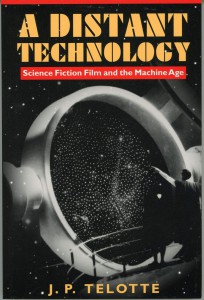
A Distant Technology
Science Fiction Film and the Machine Age (livre en anglais)


 (0 vote)
Moyenne des votes :
| 0 | vote |  = On peut s'en passer = On peut s'en passer |
| 0 | vote |  = Bon livre = Bon livre |
| 0 | vote |  = Excellent livre = Excellent livre |
| 0 | vote |  = Unique / une référence = Unique / une référence |
Votre vote : -
Description de l'ouvrage :
Science fiction films celebrate and critique the impact of a burgeoning technology on the world's cultural, political, and social milieu.
The Machine Age, roughly delineated by the two decades between World Wars, was a watershed period during which modern society entered into an ambiguous embrace with technology that continues today. J. P. Telotte carefully blends film, technology, cultural, and genre studies to illuminate this nearly forgotten era in our cinematic history and to show, through analysis of classics like The Invisible Ray, Metropolis, and Things to Come, how technology played a major role as motif, "actor," and producer.
What he also discovers as he ranges among the American, British, Russian, French, and German science fiction cinema ― as well as mainstream films, figures, and cultural products such as the New York World's Fair ― is a fundamental ambivalence, embedded in the films themselves, about the very machine-age ethos they promoted. Even as advances in the technical apparatus of filmmaking elevated it from mere entertainment to a medium of general communication and genuine artistic expression, Machine Age science fiction films remained curiously distant from and often skeptical of the very machines on which their narratives focus.
The resulting tensions, Telotte writes, "thus seem to intersect with those implicit in a Western world that was struggling with its own transition into the modern," rendering the films' task inevitably paradoxical and difficult
À propos de l'auteur :
J. P. TELOTTE is Professor of Literature, Communication, and Culture at Georgia Institute of Technology and editor of The Cult Film Experience (1991). His books include Replications: A Robotic History of the Science Fiction Film (1995), Voices in the Dark: The Narrative Patterns of Film Noir (1989), and Dreams of Darkness: Fantasy and the Films of Val Lewton (1985).
Revue de Presse :
"A Distant Technology is both knowledgable and inspiring: in teasing out the ambivalences of the sf films of the pre-War years concerning the 'Machine Age' they dramatise, the book fills a gap in science fiction history [which] many of us are unaware of as a gap."―Foundation: International Review of Science Fiction
"A rigorous film history of a crucial but generally overlooked period in the development of science fiction film which transcends genre concerns to argue the importance of Machine Age cinema in the Soviet Union, Germany, France, England and the United States in the cultural construction of technology during the 1920s and 1930s. A Distant Technology argues powerfully for centrality of film in general- and the science fiction film in particular- to the cultural construction of technology in the Western World."―Brooks London, University of Iowa
"A rigorous film history of a crucial but generally overlooked period in the development of science fiction film which transcends genre concerns to argue the importance of Machine Age cinema in the Soviet Union, Germany, France, England and the United States in the cultural construction of technology during the 1920s and 1930s. A Distant Technology argues powerfully for centrality of film in general- and the science fiction film in particular- to the cultural construction of technology in the Western World."―Brooks London, University of Iowa
"A Distant Technology provides generous international coverage of the science fiction films of the 20's and 30s, introducing readers to a fascinating array of both familiar and lesser known films. It is an enjoyable and enlightening journey through modernism's utopian and dystopian dreams of technology, dreams which we are still in the process of interpreting today."―Veronica Hollinger, Trent University
Voir le site internet de l'éditeur Wesleyan University Press
> Du même auteur :

The Oxford Handbook of New Science Fiction Cinemas (2023)
Sujet : Genre > Science Fiction
Science Fiction Double Feature (2021)
The Science Fiction Film as Cult Text
Dir. J. P. Telotte et Gerald Duchovnay
Sujet : Genre > Science Fiction
Movies, Modernism, and the Science Fiction Pulps (2019)
Sujet : Genre > Science Fiction
Science Fiction Film, Television, and Adaptation (2013)
Across the Screens
Dir. J. P. Telotte et Gerald Duchovnay
Sujet : Genre > Science Fiction

Voices in the Dark (1988)
The Narrative Patterns of Film Noir
> Sur un thème proche :
Films from the Future (2018)
The Technology and Morality of Sci-Fi Movies
Sujet : Genre > Science Fiction
Amazing Worlds of Science Fiction and Science Fact (2025)
de Keith Cooper
Sujet : Genre > Science Fiction
Societies in Space (2025)
Essays on the Civilized Frontier in Film and Television
Dir. Gary Westfahl
Sujet : Genre > Science Fiction
Robots That Love (2025)
Artificial Amours in Myth, Folklore, Literature, Popular Culture and the Real World
Sujet : Genre > Science Fiction
The Future Was Now (2025)
Madmen, Mavericks, and the Epic Sci-Fi Summer of 1982
Sujet : Genre > Science Fiction
The Science Fiction Film in Contemporary Hollywood (2025)
A Social Semiotics of Bodies and Worlds
Sujet : Genre > Science Fiction
Feminist Posthumanism in Contemporary Science Fiction Film and Media (2025)
From Annihilation to High Life and Beyond
Dir. Julia A. Empey
Sujet : Genre > Science Fiction
Female Robots and AI in Science Fiction Cinema (2025)
The Fabular Femininity of Gynoids
Sujet : Genre > Science Fiction

Cyberpunk (2024)
Envisioning Possible Futures Through Cinema
Dir. Doris Berger
Sujet : Genre > Science Fiction

Fantastic Planets, Forbidden Zones, and Lost Continents (2024)
The 100 Greatest Science-fiction Films
Sujet : Genre > Science Fiction
 Retour


