


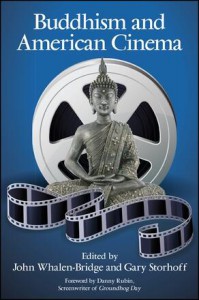
Buddhism and American Cinema
(livre en anglais)
Sous la direction de John Whalen-Bridge et Gary Storhoff


 (0 vote)
Moyenne des votes :
| 0 | vote |  = On peut s'en passer = On peut s'en passer |
| 0 | vote |  = Bon livre = Bon livre |
| 0 | vote |  = Excellent livre = Excellent livre |
| 0 | vote |  = Unique / une référence = Unique / une référence |
Votre vote : -
Description de l'ouvrage :
Discusses both depictions of Buddhism in film and Buddhist takes on a variety of films.
In 1989, the same year the Dalai Lama was awarded the Nobel Peace Prize, a decade-long boom of films dedicated to Buddhist people, history, and culture began. Offering the first scholarly treatment of Buddhism and cinema, the editors advise that there are two kinds of Buddhist film: those that are about Buddhists and those that are not. Focusing on contemporary American offerings, the contributors extend a two-pronged approach, discussing how Buddhism has been captured by directors and presenting Buddhist-oriented critiques of the worlds represented in films that would seem to have no connection with Buddhism. Films discussed range from those set in Tibet, such as Kundun and Lost Horizon, to those set well outside of any Buddhist milieu, such as Groundhog Day and The Matrix. The contributors explain the Buddhist theoretical concepts that emerge in these works, including karma, the bardo, and reincarnation, and consider them in relation to interpretive strategies that include feminism, postcolonialism, and contemplative psychological approaches.
À propos des auteurs :
John Whalen-Bridge is Associate Professor of English at the National University of Singapore. Gary Storhoff (1947–2011) was Associate Professor of English at the University of Connecticut, Stamford and the author of Understanding Charles Johnson. Together they coedited The Emergence of Buddhist American Literature, American Buddhism as a Way of Life and Writing as Enlightenment: Buddhist American Literature into the Twenty-first Century, all also published by SUNY Press.
Revue de Presse :
"In a fascinating contribution, David Harper and Richard Anderson look at how contemplative traditions in films such as The Matrix employ violence to legitimize liberation. The luminosity of film becomes a natural allegory of Buddhism, with projected fictional images attempting to connect viewers to a real world. " — CHOICE
Voir le site internet de l'éditeur State University of New York Press
> Sur un thème proche :
The Muslim World in Post–9/11 American Cinema (2018)
A Critical Study, 2001–2011
Sujet : Pays > Etats-Unis

Imagining the American Death Penalty (2025)
The Cultural Work of Popular Visual Representations
de Birte Christ
Sujet : Pays > Etats-Unis

Our Country/Whose Country? (2024)
Early Westerns and Travel Films as Stories of Settler Colonialism
de Richard Abel
Sujet : Pays > Etats-Unis
Was It Yesterday? (2022)
Nostalgia in Contemporary Film and Television
Dir. Matthew Leggatt
Sujet : Pays > Etats-Unis
Celluloid Chains (2019)
Slavery in the Americas through Film
Dir. Rudyard J. Alcocer, Kristen Block et Dawn Duke
Sujet : Pays > Etats-Unis
Cinema's Military Industrial Complex (2018)
Dir. Haidee Wasson et Lee Grieveson
Sujet : Pays > Etats-Unis
 Retour


