

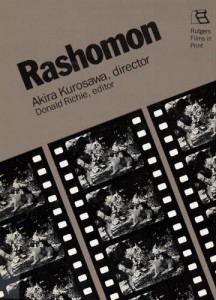
Rashomon
(livre en anglais)
Sous la direction de Donald Richie


 (0 vote)
Moyenne des votes :
| 0 | vote |  = On peut s'en passer = On peut s'en passer |
| 0 | vote |  = Bon livre = Bon livre |
| 0 | vote |  = Excellent livre = Excellent livre |
| 0 | vote |  = Unique / une référence = Unique / une référence |
Votre vote : -
Description de l'ouvrage :
Rashomon is one of the greatest of Japanese director Akira Kurosawa's films, the winner of the 1951 Venice Festival prize and the Academy Award for best foreign film in 1952. It features Toshiru Mifune, the best-known Japanese actor in the West, as the bandit, an accused rapist and murderer. At the beginning of the film, a woodcutter, priest, and commoner happen to meet at the ruined gate--Rashomon--outside the city of Kyoto. This tale of rape and murder is first seen through the eyes of the woodcutter and the priest, both of whom have been touched by the events. The cynical, detached commoner, "everyman," listens to and comments upon their stories.
The central section of the film, a series of flashbacks and tales within tales, consists of the same events retold by the husband (speaking through a medium, from the grave), the wife, the bandit, and the woodcutter. Each tells what happened--or possibly, what should have happened. The film deals with multiple truths; Richie summarizes the director's point of view in the introduction: "the world is illusion, you yourself make reality, but this reality undoes you if you submit to being limited by what you have made."
Voir la fiche de Rashômon (1950) sur le site IMDB ...
> Du même auteur :
> Sur un thème proche :
Rashomon Effects (2018)
Kurosawa, Rashomon and their legacies
Dir. Blair Davis, Robert Anderson et Jan Walls
Kurosawa's Rashomon (2016)
A Vanished City, a Lost Brother, and the Voice Inside His Iconic Films
de Paul Anderer


Kurosawa, Shakespeare and Others (2023)
Art and the Human Experience
de Anne-Marie Costantini-Cornède
Sujet : Réalisateur > Akira Kurosawa
The Russian Kurosawa (2023)
Transnational Cinema, or the Art of Speaking Differently
Sujet : Réalisateur > Akira Kurosawa


The Hero and the Grave (2018)
The Theme of Death in the Films of John Ford, Akira Kurosawa and Sergio Leone
Sujet : Réalisateur > John Ford, Akira Kurosawa, Sergio Leone
 Retour