


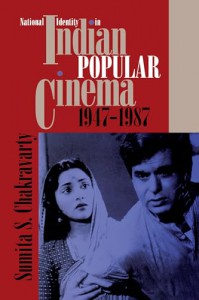
National Identity in Indian Popular Cinema
1947-1987 (livre en anglais)


 (0 vote)
Moyenne des votes :
| 0 | vote |  = On peut s'en passer = On peut s'en passer |
| 0 | vote |  = Bon livre = Bon livre |
| 0 | vote |  = Excellent livre = Excellent livre |
| 0 | vote |  = Unique / une référence = Unique / une référence |
Votre vote : -
Description de l'ouvrage :
Although Indian popular cinema has a long history and is familiar to audiences around the world, it has rarely been systematically studied. This book offers the first detailed account of the popular film as it has grown and changed during the tumultuous decades of Indian nationhood. The study focuses on the cinema’s characteristic forms, its range of meanings and pleasures, and, above all, its ideological construction of Indian national identity.
Informed by theoretical developments in film theory, cultural studies, postcolonial discourse, and “Third World” cinema, the book identifies the major genres and movements within Bombay cinema since Independence and uses them to enter larger cultural debates about questions of identity, authenticity, citizenship, and collectivity. Chakravarty examines numerous films of the period, including Guide (Vijay Anand, 1965), Shri 420 [The gentleman cheat] (Raj Kapoor, 1955), and Bhumika [The role] (Shyam Benegal, 1977). She shows how “imperso-nation,” played out in masquerade and disguise, has characterized the representation of national identity in popular films, so that concerns and conflicts over class, communal, and regional differences are obsessively evoked, explored, and neutralized.
These findings will be of interest to film and area specialists, as well as general readers in film studies.
À propos de l'auteur :
Sumita Chakravarty teaches in the department of communication in the New School for Social Research.
Voir le site internet de l'éditeur University of Texas Press
> Sur un thème proche :


Visions of Development (2016)
Films Division of India and the Imagination of Progress, 1948-75
Muslim Identity in Hindi Cinema (2025)
Poetics and Politics of Genre and Representation
Centring Women in Bollywood Biopics (2024)
Empowerment and Agency in Contemporary Indian Cinema
Postcolonial Bollywood and Muslim Identity (2024)
Production, Representation, and Reception

Beyond Bollywood (2022)
2000 Years of Dance in the Arts of South Asia, Southeast Asia, and the Himalayan Region
Dir. Forrest McGill
 Retour


