


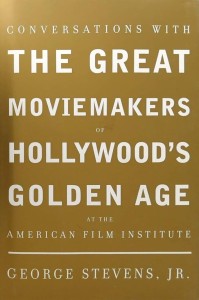
Conversations with the Great Moviemakers of Hollywood's Golden Age
At the American Film Institute (livre en anglais)
Sous la direction de George Stevens Jr.


 (0 vote)
Moyenne des votes :
| 0 | vote |  = On peut s'en passer = On peut s'en passer |
| 0 | vote |  = Bon livre = Bon livre |
| 0 | vote |  = Excellent livre = Excellent livre |
| 0 | vote |  = Unique / une référence = Unique / une référence |
Votre vote : -
Description de l'ouvrage :
The first book to bring together these interviews of master moviemakers from the American Film Institute’s renowned seminars—a series that has been in existence for almost forty years, since the founding of the Institute itself.
Here are the legendary directors, producers, cinematographers and writers—the great pioneers, the great artists—whose work led the way in the early days of moviemaking and still survives from what was the twentieth century’s art form. The book is edited—with commentaries—by George Stevens, Jr., founder of the American Film Institute and the AFI Center for Advanced Film Studies’ Harold Lloyd Master Seminar series.
Here talking about their work, their art—picture making in general—are directors from King Vidor, Howard Hawks and Fritz Lang (“I learned only from bad films”) to William Wyler, George Stevens and David Lean.
Here, too, is Hal Wallis, one of Hollywood’s great motion picture producers; legendary cinematographers Stanley Cortez, who shot, among other pictures, The Magnificent Ambersons, Since You Went Away and Shock Corridor and George Folsey, who was the cameraman on more than 150 pictures, from Animal Crackers and Marie Antoinette to Meet Me in St. Louis and Adam’s Rib; and the equally celebrated James Wong Howe.
Here is the screenwriter Ray Bradbury, who wrote the script for John Huston’s Moby Dick, Fahrenheit 451 and The Illustrated Man, and the admired Ernest Lehman, who wrote the screenplays for Sabrina, Who’s Afraid of Virginia Woolf and North by Northwest (“One day Hitchcock said, ‘I’ve always wanted to do a chase across the face of Mount Rushmore.’”).
And here, too, are Ingmar Bergman and Federico Fellini (“Making a movie is a mathematical operation. It’s absolutely impossible to improvise”).
These conversations gathered together—and published for the first time—are full of wisdom, movie history and ideas about picture making, about working with actors, about how to tell a story in words and movement.
A sample of what the moviemakers have to teach us:
Elia Kazan, on translating a play to the screen: “With A Streetcar Named Desire we worked hard to open it up and then went back to the play because we’d lost all the compression. In the play, these people were trapped in a room with each other. As the story progressed I took out little flats, and the set got smaller and smaller.”
Ingmar Bergman on writing: “For half a year I had a picture inside my head of three women walking around in a red room with white clothes. I couldn’t understand why these damned women were there. I tried to throw it away . . . find out what they said to each other because they whispered. It came out that they were watching another woman dying. Then the screenplay started—but it took about a year. The script always starts with a picture . . . ”
Jean Renoir on actors: “The truth is, if you discourage an actor you may never find him again. An actor is an animal, extremely fragile. You get a little expression, it is not exactly what you wanted, but it’s alive. It’s something human.”
And Hitchcock—on Hitchcock: “Give [the audience] pleasure, the same pleasure they have when they wake up from a nightmare.”
À propos de l'auteur :
George Stevens, Jr., is an award-winning writer, director and producer, and founder of the American Film Institute. He has received eleven Emmys, two Peabody Awards and seven Writers Guild of America Awards for his television productions, including the annual Kennedy Center Honors, The Murder of Mary Phagan and Separate but Equal. His production The Thin Red Line was nominated for seven Academy Awards, including best picture. He worked with his father, acclaimed director George Stevens, on his productions of Shane, Giant and The Diary of Anne Frank and in 1962 was named head of the United States Information Agency's motion picture division by Edward R. Murrow. Stevens was director of the AFI from 1967 until 1980, before returning to film and television production. He lives in Washington, D.C.
Revue de Presse :
"As a lover of films, I was absolutely fascinated by The Great Moviemakers of Hollywood’s Golden Age." –Dominick Dunne
"These vivid, immediate conversations remind us what extraordinary people came together to form what we call the Golden Age of Hollywood." –Leonard Maltin
"This book, lovingly put together from hundreds of dialogues with some of the greatest directors, writers and technicians who ever worked in the medium, is a precious resource for filmmakers at all stages. If you want to learn about movies, Conversations is invaluable, and it’s equally invaluable to those of us who may want to recharge our batteries and look to the masters for inspiration. And for people who simply love movies, it’s a joy to read." —Martin Scorsese
"A remarkable time capsule containing the voices and memories and insights of these men who made the movies we love. What a gift! Leap anywhere into Stevens’ astonishing treasure trove; you’ll be hooked, rewarded, surprised, and pleased." —John Guare
"If there is a single volume that magically illuminates the history and the art of the movies, this is it." —Arthur Schlesinger, Jr.
"Superb . . . Entertaining . . . Edited with grace and clarity, allowing the personality of each subject to emerge . . . As invaluable as the book is for film historians and future filmmakers, it’ll also delight anyone fascinated by movies and their makers." —Publishers Weekly (starred review)
"Without question, the AFI seminars represent the most important gathering ever of master filmmakers under one program. There's a precision to these discussions often lacking in interviews and memoirs. For anyone interested in what it takes to make great movies, this book will be an important new resource." —James Curtis, author of W.C. Fields: A Biography
Voir le site internet de l'éditeur Knopf
> Du même auteur :
My Place in the Sun (2024)
Life in the Golden Age of Hollywood and Washington
Sujet : Réalisateur > George Stevens Jr.
Conversations at the American Film Institute with the Great Moviemakers (2012)
The Next Generation
Sujet : Réalisateur
> Sur un thème proche :
They Made the Movies (2024)
Conversations With Great Filmmakers
de James Bawden et Ron Miller
Sujet : Réalisateur
Independent Female Filmmakers (2019)
A Chronicle through Interviews, Profiles, and Manifestos
Dir. Michele Meek
Sujet : Réalisateur
Behind the Scenes with Hollywood Producers (2016)
Interviews with 14 Top Film Creators
de Duane Byrge
Sujet : Réalisateur
 Retour


