


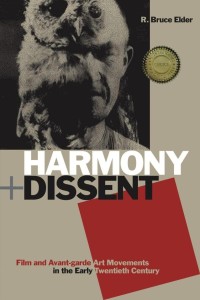
Harmony and Dissent
Film and Avant-garde Art Movements in the Early Twentieth Century (livre en anglais)


 (0 vote)
Moyenne des votes :
| 0 | vote |  = On peut s'en passer = On peut s'en passer |
| 0 | vote |  = Bon livre = Bon livre |
| 0 | vote |  = Excellent livre = Excellent livre |
| 0 | vote |  = Unique / une référence = Unique / une référence |
Votre vote : -
Description de l'ouvrage :
R. Bruce Elder argues that the authors of many of the manifestoes that announced in such lively ways the appearance of yet another artistic movement shared a common aspiration: they proposed to reformulate the visual, literary, and performing arts so that they might take on attributes of the cinema. The cinema, Elder argues, became, in the early decades of the twentieth century, a pivotal artistic force around which a remarkable variety and number of aesthetic forms took shape.
To demonstrate this, Elder begins with a wide-ranging discussion that opens up some broad topics concerning modernity’s cognitive (and perceptual) regime, with a view to establishing that a crisis within that regime engendered some peculiar, and highly questionable, epistemological beliefs and enthusiasms. Through this discussion, Elder advances the startling claim that a crisis of cognition precipitated by modernity engendered, by way of response, a peculiar sort of “pneumatic (spiritual) epistemology.” Elder then shows that early ideas of the cinema were strongly influenced by this pneumatic epistemology and uses this conception of the cinema to explain its pivotal role in shaping two key moments in early-twentieth-century art: the quest to bring forth a pure, “objectless” (non-representational) art and Russian Suprematism, Constructivism, and Productivism.
À propos de l'auteur :
R. Bruce Elder is an award-winning filmmaker and teaches media at Ryerson University. His book Harmony & Dissent (WLU Press, 2008) received the prestigious Robert Motherwell Book Prize and was named a Choice Outstanding Academic Book. Rudolf Kuenzli described DADA, Surrealism, and the Cinematic Effect (WLU Press, 2013) as “that rare book that casts the early twentieth-century avant-garde in a very new light.”
Revue de Presse :
To his credit, Elder brings self-assured skepticism to the movements and manifestos he probes, stating at the outset that the spiritual interests of the early film and photography avant-gardes ‘were largely of a peculiar, woolly character’ and that he is scrutinizing these notions ‘in order to expose the stain that marks them’ (xi). Having said this, however, he pays them the respect of sustained and serious examination; he comes to illuminate them, not to bury them, and he provides us with more than enough information to arrive at our own conclusions while pondering his. He explicates, you decide. Working out his thesis in almost 500 scrupulously researched pages, complete with hundreds of endnotes and quotations in Greek and Cyrillic script, Elder visits some historical areas that others have charted in the past, but which take on new significances in this distinctive context, especially when analyzed in such meticulous detail. At other times he sets forth facts, hypotheses, and speculations that I've encountered nowhere else.... Harmony and Dissent is as expansive, imaginative, fact-filled, and action-packed as any film-related book I've come upon in ages. Like most of the artists, theorists, inventors, mystics, and visionaries he writes about, Elder is blessed with a sense of mission that rules out shortcuts and compromises. The result of his labour is intensely challenging at times, but its insights are copious and its scholarship is a wonder to behold. -- David Sterritt, Quarterly Review of Film and Video, 28:5, 2012 April
Elder's research is staggering; form Platonic thought, Leonardo's Trattato dell pittura, analytical Newtonian principles governing the relationship between acoustics and optics, and Rudolf Steiner's anthroposophical treatises, to Jean-Philippe Rameau's notions on harmony and Viking Eggeling's film Diagonal-Symphonie.... Elder presents a radically altered perspective on the origins and influences that helped propel the artistic sensibilities of the early twentieth-century avant-garde in this absorbing text. Harmony and Dissent is highly recommended, in general, for those interested in pneumatic epistemology, film and visual arts in Russia and Europe and, more specifically, for academics and advanced students of Russian and Soviet cultural and cinema studies. -- Ilana Sharp, Subiaco, Western Australia, Studies in Russian and Soviet Cinema, 3.3, November 2009, 2010 February
With a distinguished career as a filmmaker and critic, Elder (Ryerson Univ.) comes qualified to discuss this subject. In this rich, complex book, he sets out to explore both the 'absolute film tradition' as it developed principally in Germany and France (particularly in the work of Walther Ruttman, Hans Richter and Viking Eggeling) and the development of constructivism in the Russian tradition (especially in the work of Sergei Eisenstein).... Elder's masterful book is a must for everyone interested in cinematic modernism, particularly the early-20th-century European avant-gardes. Summing Up: Essential. -- K.S. Nolley, Williamette University, Choice, 2009 June
Voir le site internet de l'éditeur Wilfrid Laurier University Press
> Du même auteur :
Image and Identity (2006)
Reflections on Canadian Film and Culture
> Sur un thème proche :
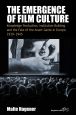
The Emergence of Film Culture (2017)
Knowledge Production, Institution Building, and the Fate of the Avant-Garde in Europe, 1919–1945
Dir. Malte Hagener
Sujet : Histoire du cinéma
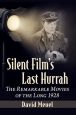
Silent Film's Last Hurrah (2023)
The Remarkable Movies of the Long 1928
de David Meuel
Sujet : Cinéma muet

Film Posters of the Russian Avant-Garde (2021)
de Susan Pack
(en anglais, français et allemand)
Sujet : Pays > Russie / URSS
The Men with the Movie Camera (2016)
The Poetics of Visual Style in Soviet Avant-Garde Cinema of the 1920s
Sujet : Pays > Russie / URSS
 Retour


