

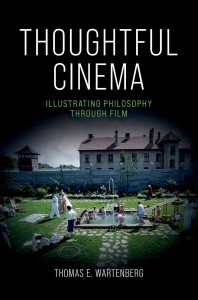
Thoughtful Cinema
Illustrating Philosophy Through Film (livre en anglais)


 (0 vote)
Moyenne des votes :
| 0 | vote |  = On peut s'en passer = On peut s'en passer |
| 0 | vote |  = Bon livre = Bon livre |
| 0 | vote |  = Excellent livre = Excellent livre |
| 0 | vote |  = Unique / une référence = Unique / une référence |
Votre vote : -
Description de l'ouvrage :
Anyone who has seen a film and then followed up with a cup of coffee or glass of wine as they discuss it with friends knows that films can inspire thoughtful conversation and further reflection--sometimes long after their initial screening. Thoughtful Cinema explores how films raise and suggest answers to philosophical questions through an in-depth analysis of how seven films engage with various philosophical traditions, ranging from the nineteenth-century German philosopher Friedrich Nietzsche to the twentieth- and twenty-first-century American philosopher Judith Jarvis Thomson.
Films can do philosophy, this book argues, as a result of their ability to illustrate philosophical claims and theories. However, the films discussed in this book do much more than that: they also supplement the philosophies they illustrate by expanding their claims and criticizing their assumptions. Films, therefore, can make their own independent contributions to philosophical theory. Thoughtful Cinema shows how films grapple with philosophical ideas such as personal identity, the banality of evil, authenticity, euthanasia, third-party killing, and the power of attention. This book makes an important contribution to the debate about cinematic philosophy that has engaged both philosophers of film and film theorists for decades, and it also proves that philosophy is not just a narrow specialty, accessible only to trained practitioners. Films that do philosophy address the essential concerns of human life, and it's this characteristic-their philosophical attention--that makes them appeal to a wide audience.
À propos de l'auteur :
Thomas E. Wartenberg's research areas include aesthetics, the philosophy of film, and philosophy for children. He is the author or editor of 16 previous books including Thoughtful Images (OUP 2023), Big Ideas for Little Kids (R&L Education 2009), Thinking on Screen (Routledge 2007), Existentialism: A Beginners Guide (Oneworld 2008), and Unlikely Couples (Westview Press 1999).
> Du même auteur :
> Sur un thème proche :
Thinking in the Dark (2015)
Cinema, Theory, Practice
Dir. Murray Pomerance et R. Barton Palmer
Sujet : Théorie
Tuitions and Intuitions (2019)
Essays at the Intersection of Film Criticism and Philosophy
Sujet : L'analyse de films
Jung and Film II (2011)
The Return: Further Post-Jungian Takes on the Moving Image
Dir. Christopher Hauke et Luke Hockley
Sujet : L'analyse de films
Critical Terms for Media Studies (2010)
Dir. W. J. T. Mitchell et Mark B. N. Hansen
Sujet : L'analyse de films
Jung and Film (2001)
Post-Jungian Takes on the Moving Image
Dir. Christopher Hauke et Ian Alister
Sujet : L'analyse de films
 Retour


