


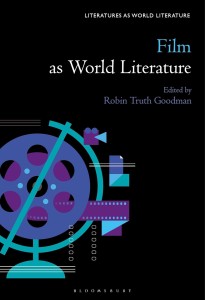
Film as World Literature
(livre en anglais)
Sous la direction de Robin Truth Goodman


 (0 vote)
Moyenne des votes :
| 0 | vote |  = On peut s'en passer = On peut s'en passer |
| 0 | vote |  = Bon livre = Bon livre |
| 0 | vote |  = Excellent livre = Excellent livre |
| 0 | vote |  = Unique / une référence = Unique / une référence |
Votre vote : -
Description de l'ouvrage :
Redefines the theoretical and thematic contents of world literature by considering it in connection with film.
What gets lost when we understand film as essentially different from literature? What gets lost when we think them essentially the same? Does the constructed difference between literature and film also create social and political exclusions, exclusions that may exacerbate class struggle or exclusions of certain ways of thinking the future as different? Film as World Literature seeks to undo disciplines and disciplinarity: the division between film and literature, indeed, conceals the possibilities of “world” by bracketing out “undisciplined” parts.
Contributors apply ideas of “translatability” and “untranslatability” not just as a linguistic exercise of transfers between language groups, cultures, and national origins but also as an approach to media and transfers between media. Is film a visual acknowledgement that literary language is, by definition, multilingual – that is, is film a place where political conflicts, as Bakhtin observed, can be rendered visible? Chapters discuss film's relation to world literature not only by considering literary adaptations across nations, regions, languages, ideologies, and contexts but also by exploring film's intersections with literary theory, narrative, history, genre, and experimentation.
Film as World Literature calls for recognition that while the category of “world” demands a radical defense in the face of risks to democracy, the world that literature and film combined bring forth must interrogate the conditions for a future politics of interaction, engagement, belonging, and difference.
À propos de l'auteur :
Robin Truth Goodman is Professor of English at Florida State University, USA. Her many previous publications include Gender Commodity: Marketing Feminist Identities and the Promise of Security (Bloomsbury, 2022), The Bloomsbury Handbook of 21st Century Feminist Theory (Bloomsbury, 2019); Promissory Notes: On the Literary Conditions of Debt (2018); Gender for the Warfare State: Literature of Women in Combat (2017); and Literature and the Development of Feminist Theory (2016).Sofia Ahlberg is Vice Dean at the Faculty of Languages at Uppsala University, Sweden.Thomas O. Beebee is Distinguished Professor of Comparative Literature and German, Penn State University, USA. He is the author of Millennial Literatures of the Americas, 1492-2002 (2008), Epistolary Fiction in Europe (1999), The Ideology of Genre: A Comparative Study of Generic Instability (1994) and Clarissa on the Continent: Translation and Seduction (1990).
Revue de Presse :
"In the face of the predominantly Anglocentric studies of film adaptations of literature, Film as World Literature lives up to its title by delivering an exciting collection of eminently 'worldly' essays. The volume is especially valuable as it charts a conversation on the margins of major industries, countries, and topics. Not only does it show what became world-wide currents such as neo-realism, but it also explores
cinema and media on the margins, ranging from mainstream commercial cinema (James Bond) to questions of evolving media technologies (the internationalization of screen culture through streaming apps)." ―Robert Stam, University Professor, New York University, USA
"Film as World Literature breaks new ground in literary, film, and cultural studies. Blending rich theoretical insights with diverse case studies, this volume examines adaptation, genre, and transmedia storytelling, and would be an essential resource for scholars and students." ―Rini Bhattacharya Mehta, Associate Professor of Comparative and World Literature, University of Illinois at Urbana-Champaign, USA
> Du même auteur :
Cinema and the Political Imagination (2024)
Third Cinema and Its After-Image
Sujet : Pays > Amérique latine
> Sur un thème proche :
Catherine Malabou and Contemporary French Literature and Film (2026)
Witnessing Plasticity
Artificial Generation (2021)
Photogenic French Literature and the Prehistory of Cinematic Modernity
Sujet : Technique > Adaptation
When Stories Travel (2012)
Cross-Cultural Encounters Between Fiction and Film
Sujet : Technique > Adaptation
Radical Embodiment on Film (2026)
Time and the Cinematic Body
Dir. Louis Bayman et Davina Quinlivan
Sujet : Théorie
The Attractions of the Moving Image (2025)
Essays on History, Theory, and the Avant-Garde
de Tom Gunning
Sujet : Théorie
 Retour


