

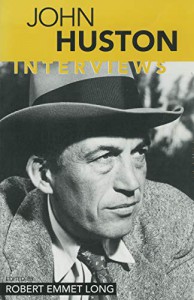
John Huston
Interviews (livre en anglais)
Sous la direction de Robert Emmet Long


 (0 vote)
Moyenne des votes :
| 0 | vote |  = On peut s'en passer = On peut s'en passer |
| 0 | vote |  = Bon livre = Bon livre |
| 0 | vote |  = Excellent livre = Excellent livre |
| 0 | vote |  = Unique / une référence = Unique / une référence |
Votre vote : -
Description de l'ouvrage :
This collection of interviews brings the filmmaker John Huston vividly to life in his own words. Huston (1906-1987) had an extraordinary career that spanned more than forty years and nearly fifty films. Among these are such classics as The Maltese Falcon, Key Largo, The Treasure of the Sierra Madre, The African Queen, The Night of the Iguana, Prizzi's Honor, and The Dead.
In these interviews ranging from 1952 to 1985 Huston talks about his approach to directing, the influence of painting upon his camera work, his association with stellar actors (Humphrey Bogart, Montgomery Clift, Errol Flynn, Marilyn Monroe, and others), his beginnings in Hollywood as a screenwriter, and the influence that the authors James Joyce and Ernest Hemingway had on his movies. Full of anecdotes about writers, directors, and actors with whom he collaborated, John Huston appears here as a man who had a rich, full life-amateur boxer, vagrant artist, painter, big-game hunter, director, and born storyteller.
As a filmmaker particularly identified with the literary masterworks he transformed into cinema (Flannery O'Connor's Wise Blood, James Joyce's The Dead, Herman Melville's Moby Dick, and Tennessee Williams's The Night of the Iguana), Huston explores literary influences on his films. For him the act of writing is essential and basic. "I don't make a distinction between writing and direction," he says. "But to write and to direct one's own material is certainly the best approach. The directing is kind of an extension of the writing."
Huston is known also for his innovative interaction with actors. In 1952 he said, "The trick is in the writing and casting. If you cast the right people, using only good actors, and adjust the script to suit the actors you've chosen, then it's best to leave them to work out their own gestures and movements. Your job is to explain to them the effect you want, and your skill lies in being able to do that exactly and vividly."
The Huston who emerges from these interviews is a gifted raconteur, an admirable professional, and indeed a figure whose real life matched his prodigious legend.
Voir le site internet de l'éditeur University Press of Mississippi
Voir la filmographie complète de John Huston sur le site IMDB ...
> Livres ayant un titre identique ou proche :
John Huston (2010)
Essays on a Restless Director
Dir. Tony Tracy et Roddy Flynn
Sujet : Réalisateur > John Huston
> Du même auteur :
James Ivory in Conversation (2006)
How Merchant Ivory Makes Its Movies
Sujet : Réalisateur > James Ivory
> Sur un thème proche :
John Huston (2010)
Essays on a Restless Director
Dir. Tony Tracy et Roddy Flynn
Sujet : Réalisateur > John Huston
Sydney Pollack (2026)
Collected Interviews
Dir. Patrick McGilligan et Paul Cronin
Sujet : Réalisateur > Sydney Pollack
Krzysztof Kieślowski (2024)
Interviews
Dir. Renata Bernard et Steven Woodward
Sujet : Réalisateur > Krzysztof Kieslowski
D. A. Pennebaker (2024)
Interviews
Dir. Keith Beattie et Trent Griffiths
Sujet : Réalisateur > D.A. Pennebaker


 Retour


