

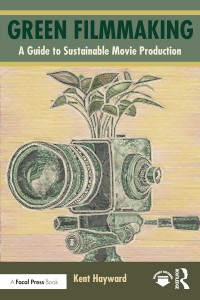
Green Filmmaking
(livre en anglais)
de Kent Hayward


 (0 vote)
Moyenne des votes :
| 0 | vote |  = On peut s'en passer = On peut s'en passer |
| 0 | vote |  = Bon livre = Bon livre |
| 0 | vote |  = Excellent livre = Excellent livre |
| 0 | vote |  = Unique / une référence = Unique / une référence |
Votre vote : -
Description de l'ouvrage :
Beyond the principles of reduce, reuse, recycle, this book looks at how every department on a production can minimize its environmental impact.
Is your filmmaking contributing to the environmental crisis, or is it part of the solution? How can film students make movies in a more ecologically friendly way so that our planet can continue to be inhabited by humans who watch their films? This book suggests step-by-step ways that each person and department on a film’s production can make simple changes to reduce their project’s environmental footprint, from including climate content to offering vegetarian craft service options.
It is an essential guide for film students, graduates, and professionals engaged in the practice of making movies.
À propos de l'auteur :
Kent Hayward is a filmmaker, Associate Professor of Production at California State University Long Beach, and a cofounder and vice-Chair of the Green Film School Alliance, a consortium committed to integrating sustainable production practices into film school programs. Previously, Hayward worked in visual effects and editorial on films including The Dark Knight, Inception, and Terminator 3: Rise of the Machines, and on TV shows for NBC Universal, SyFy, and Lifetime. Hayward’s films include Lunar Estates, August, Sunset to Sunset, and Homestead Artifact. He earned his BA at the University of Wisconsin-Madison and his MFA at the California Institute of the Arts. Currently, Hayward is working on an essay film on themes ranging from the environmental havoc that humankind has wreaked on the planet to the enduring mystery of Bigfoot.
Voir le site internet de l'éditeur Routledge
> Sur un thème proche :
Elemental World Cinema (2025)
Cinematic Entanglements of Earth, Fire, Water and Air
Dir. Tiago de Luca et Matilda Mroz
Sujet : Sociologie

Negative Life (2024)
The Cinema of Extinction
de Steven Swarbrick et Jean-Thomas Tremblay
Sujet : Sociologie
 Retour


